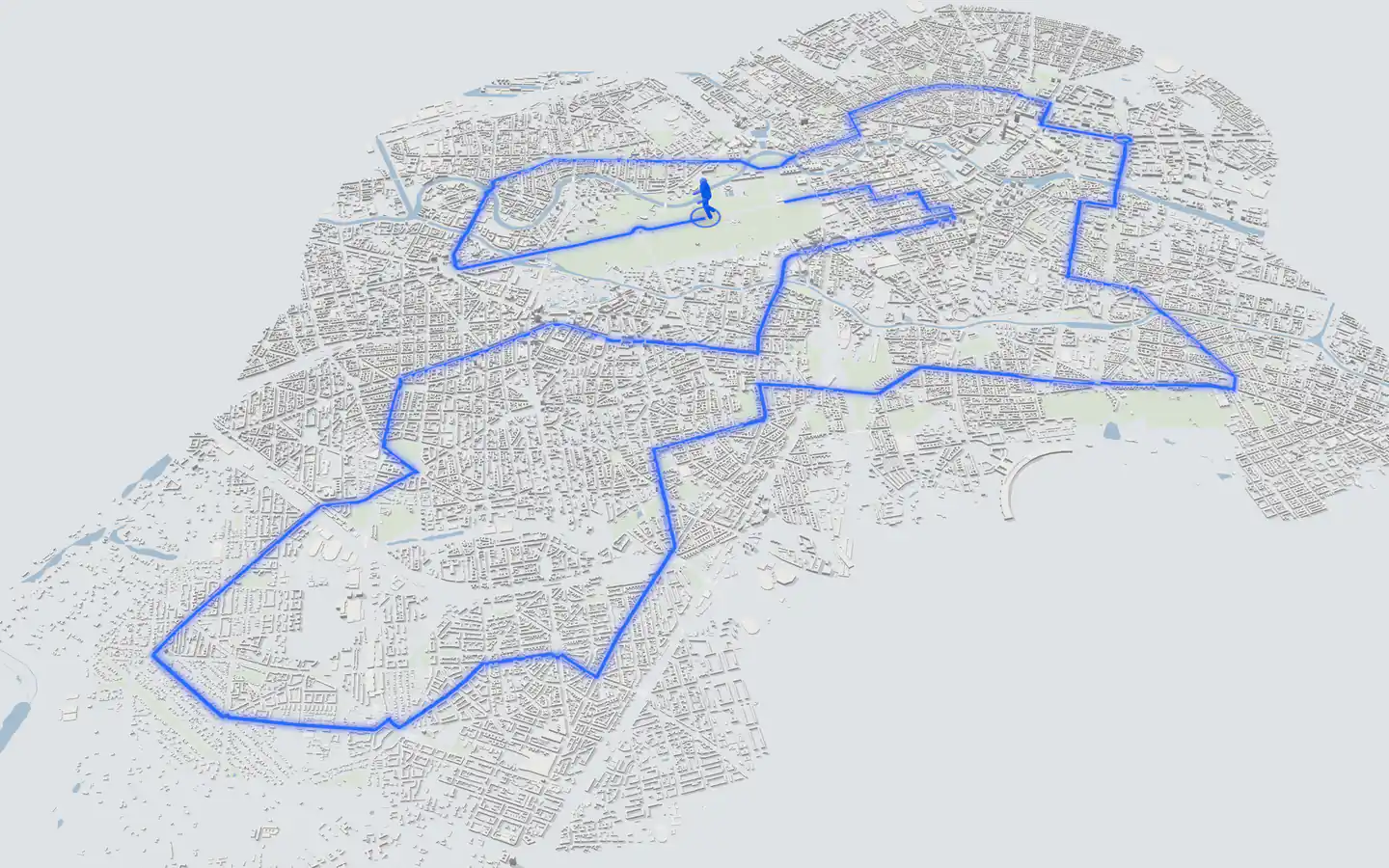
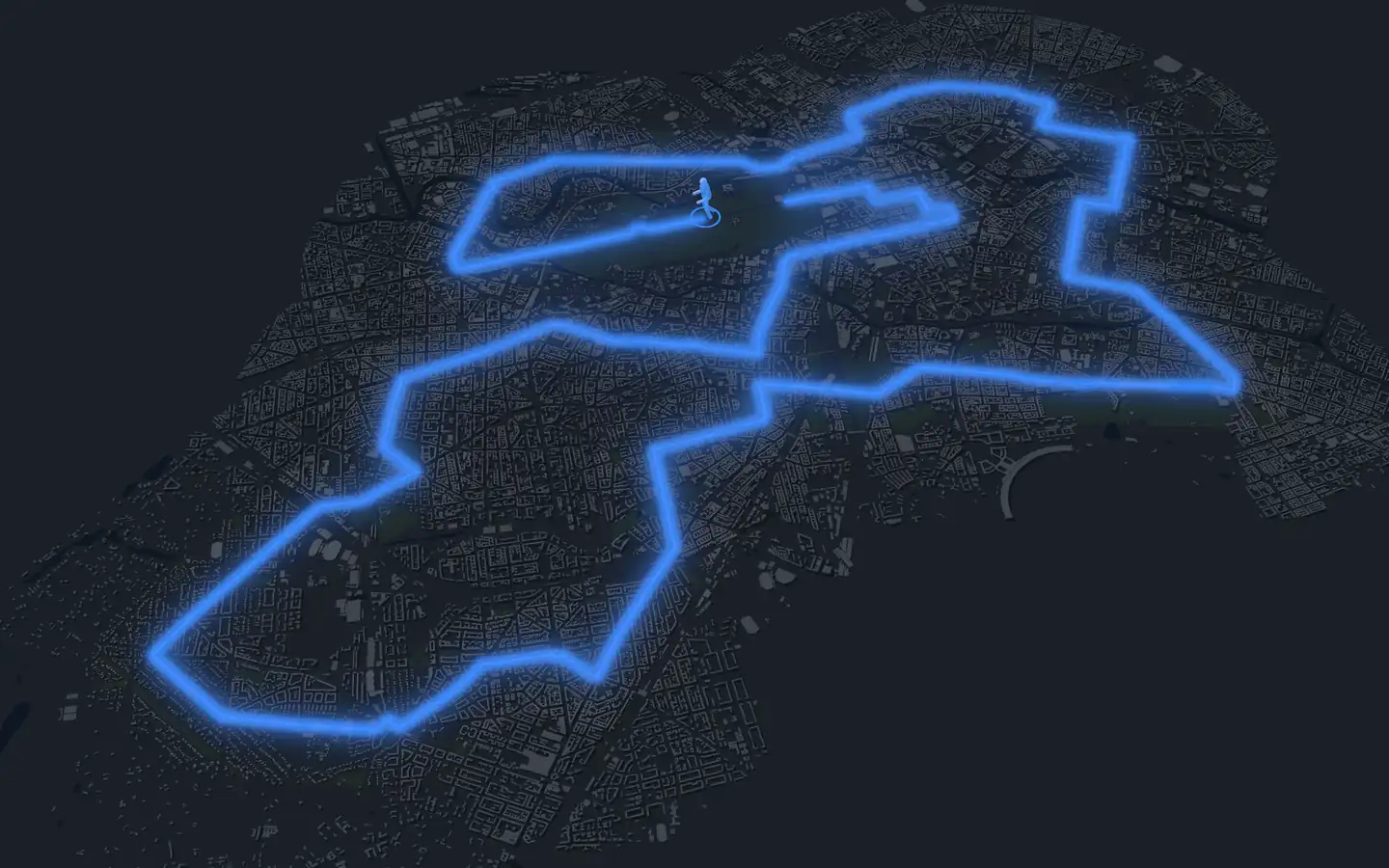
Berlin is the fastest marathon course in the world, and the flatness is the least of the
reason. The loop climbs 35.9 m over 42.2 km, and its one real rise sits in the quiet southwest between km 26 and km 28. What shapes the race is where the corners fall. There
are 44 of them, 21 before halfway and only ten after km 30, then six right angles in the last
2.3 km. A runner who holds back on the wide early boulevards, where nothing pushes back, has
the best road on earth for the second half.
The kilometres and heights below are measured along the organiser’s 2026 course, matched to the
streets and sampled on Berlin’s one-metre terrain model. The organiser has not published a 2027
course map yet, so check its course
page before you plan your
pacing.
Km 0 to 2.6: west through the Tiergarten
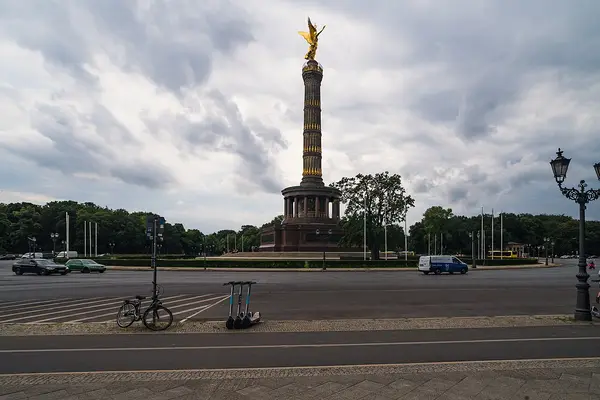
Km 0.6 Victory Column
Photo: Flocci Nivis, CC BY 4.0
The start is on Straße des 17. Juni between the Brandenburg Gate and the Kleiner Stern, and the
field runs west, away from the Gate. The road is about fifty metres wide, so nothing bunches and
nothing slows you down. That is the first trap: there is no wall of runners to tell you the
opening kilometres are too fast. At about km 0.7 the course rounds the Großer Stern and passes
66 m from the Siegessäule, then carries on west to Ernst-Reuter-Platz at km 2.6.
Km 2.6 to 8.3: Moabit and the government quarter
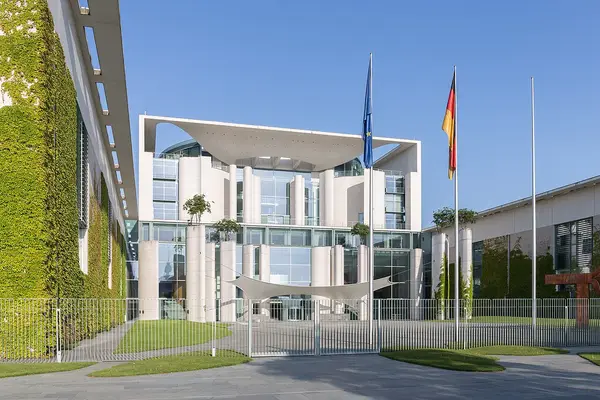
Km 6.7 Federal Chancellery
Photo: Ansgar Koreng, CC BY 3.0 de
The course turns north on Marchstraße and Franklinstraße, crosses the Spree on the
Gotzkowskybrücke at about km 3.7 and runs 2.6 km along Alt-Moabit. The lowest point of the whole
race, 33.1 m, comes at about km 4.5. At km 6.6 it crosses the Spree again on the Moltkebrücke
and passes through the government quarter on Otto-von-Bismarck-Allee and Konrad-Adenauer-Straße,
then along Reinhardtstraße to Friedrichstraße at about km 8.
Km 8.3 to 12.1: Torstraße and Karl-Marx-Allee
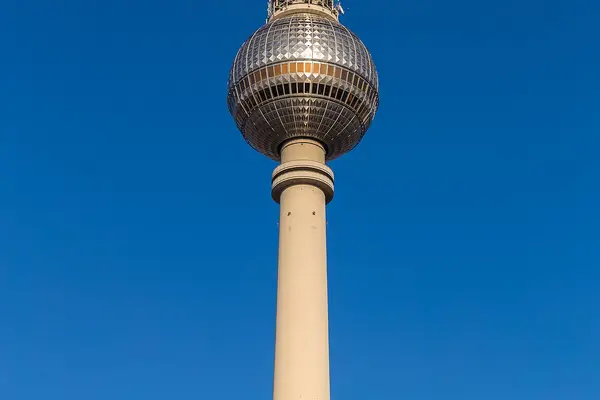
Km 10.8 TV Tower
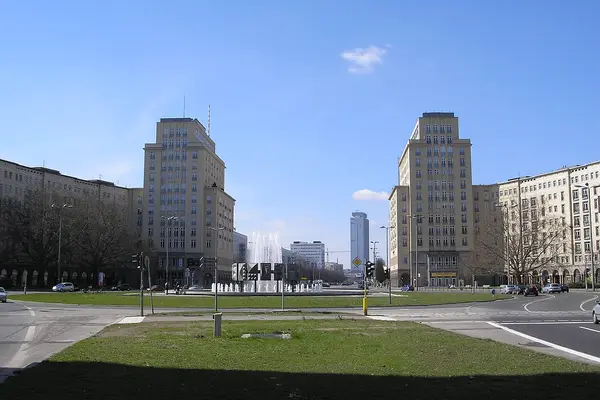
Photo: Ansgar Koreng, CC BY 4.0Km 11.9 Strausberger Platz
Photo: Gryffindor, Public domain
Torstraße takes the course 2 km east through Rosenthaler Platz, then Mollstraße and
Otto-Braun-Straße lead onto Karl-Marx-Allee at km 11.1. The Fernsehturm is about 500 m away
here, the nearest the course comes to it. Strausberger Platz, at about km 12, is where the
course swings south. The corners come thick and fast in this first half, but none of the 44 on
the course is a hairpin.
Km 12.1 to 21.1: Kreuzberg and the canal
Km 15.3 Kottbusser Tor
Photo: Axel Mauruszat, CC BY 2.0 de
The course crosses the Spree a third time on the Michaelbrücke at km 12.8, then runs south on
Heinrich-Heine-Straße and Prinzenstraße to Kottbusser Tor at about km 15.3. Kottbusser Damm
crosses the Landwehr Canal and reaches Hermannplatz at km 16.6. From there it turns west along
Hasenheide, past Südstern and down Gneisenaustraße, and Yorckstraße carries it 1.5 km west from
km 19.3. Halfway comes on Goebenstraße, just before it meets Potsdamer Straße, with nearly half
the corners of the race already behind you. The ground has barely moved: 34.5 m at halfway
against 33.6 m at the start.
Km 21.1 to 29.4: Schöneberg, the southwest and the only climb
Grunewaldstraße, Martin-Luther-Straße and Hauptstraße lead southwest through Schöneberg, and
from about km 22 the road starts rising gently, to 42.7 m at km 25. After a short dip it climbs
again: from 39.8 m at km 26.0, along Südwestkorso and Lentzeallee, to the high point of the
course, 51.4 m, at about km 28.2. That is 11.6 m in 2.2 km, but it is the closest Berlin comes to a climb. It also comes in the residential southwest, roughly km 25 to 30, where the buildings
drop from six storeys to four and the crowds thin to knots at the junctions. Tiredness and quiet
arrive together here.
Km 29.4 to 33.3: Hohenzollerndamm and the one descent
Rheinbabenallee brings the course onto Hohenzollerndamm at km 29.4, and from there it runs
downhill for most of four kilometres, with a short rise around km 31. By km 33.3 it is back down
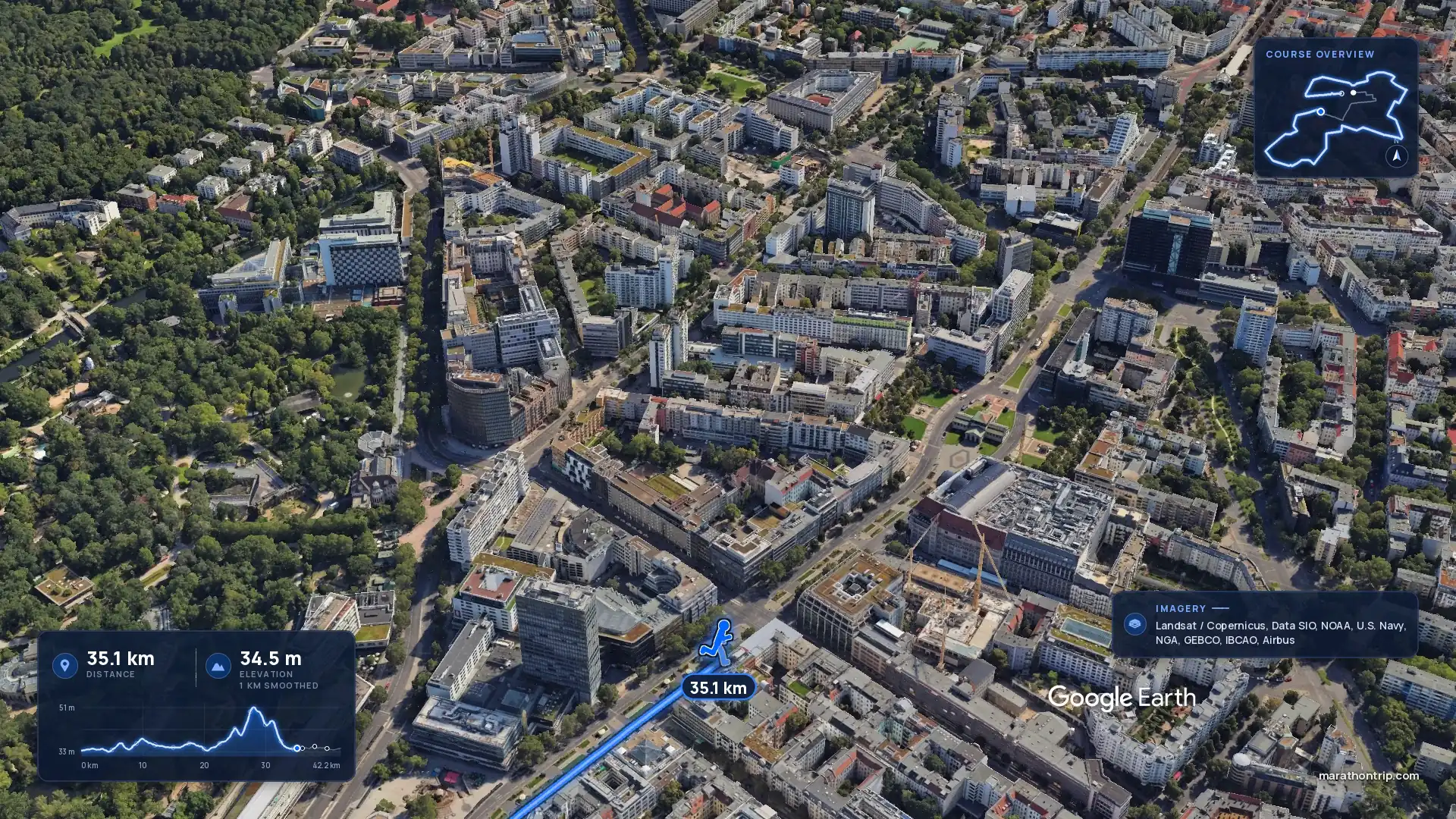
to 35 m, the only real descent of the race. The single sharpest corner on the course comes on
the way down: a left turn of about 106 degrees into Fehrbelliner Platz at km 32.1.
Brandenburgische Straße and Konstanzer Straße lead to Olivaer Platz, close to the km 33 cut-off
point.
Km 33.3 to 39.9: Kurfürstendamm to Potsdamer Platz
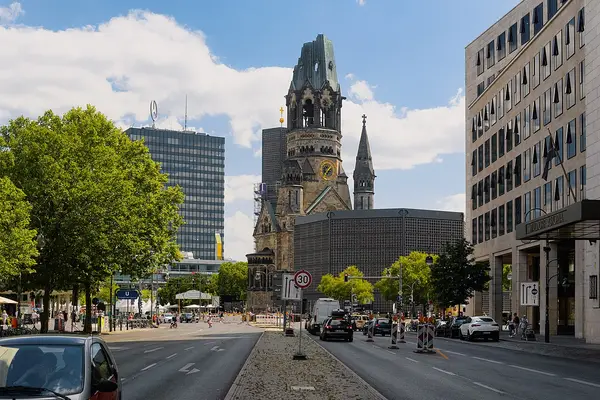
Km 34.9 Kaiser Wilhelm Memorial Church
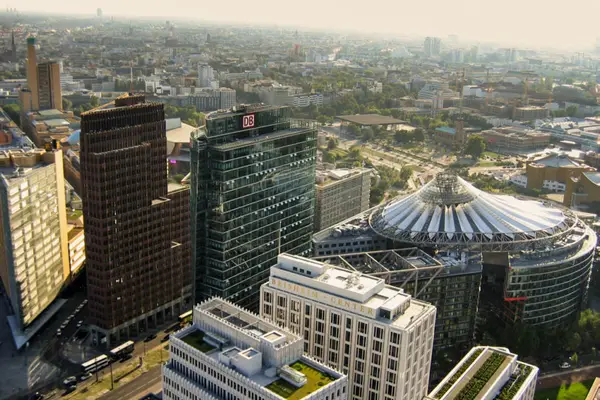
Photo: Flocci Nivis, CC BY 4.0Km 38.5 Potsdamer Platz
Photo: Michael J. Zirbes, Public domain
From Olivaer Platz the course turns hard exactly once in 6.6 km. Kurfürstendamm and
Tauentzienstraße take it 2 km east, then Kleiststraße and Bülowstraße lead to Potsdamer Straße
at km 36.8. It crosses the Landwehr Canal on the Potsdamer Brücke at km 37.8 and reaches
Potsdamer Platz at km 38.5. Leipziger Straße runs another 1.2 km east, flat at about 35 m. This
is the middle of the city again, and the stretch to hold your pace on before the corners start.
Km 39.9 to 42.2: six right angles and the Gate
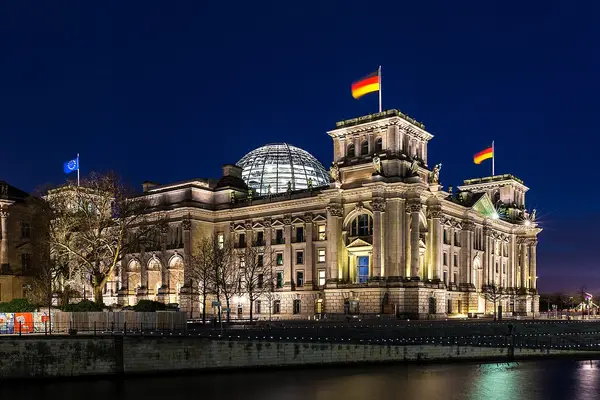
km 41.9 Reichstag
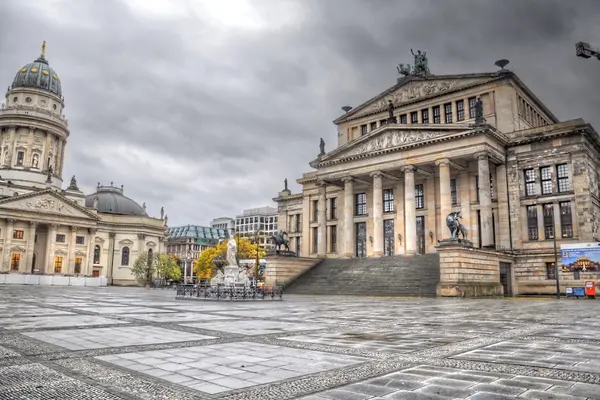
Km 40.4 Gendarmenmarkt
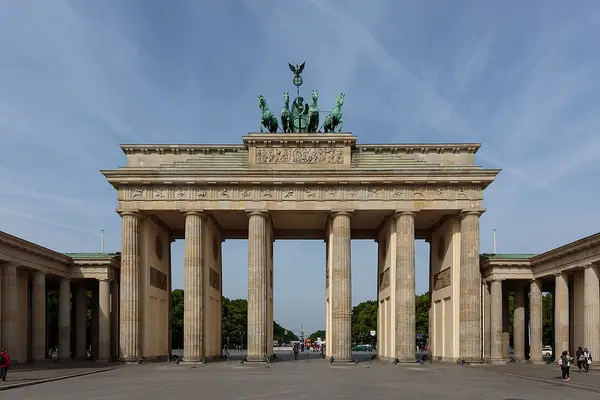
Photo: Christoph Matthias Siebenborn, CC BY 3.0Km 41.8 Brandenburg Gate
Photo: Pierre-Selim Huard, CC BY 4.0
The course saves six hard corners for the end, at km 39.9, 40.1, 40.3, 40.6, 41.0 and 41.3:
left, left, right, left, right, left. The first two, onto Jerusalemer Straße and then
Anton-Wilhelm-Amo-Straße, are 174 m apart and together make the only complete reversal on the
course. Markgrafenstraße, Französische Straße and Glinkastraße lead onto Unter den Linden at km
41.3. That is six slow-downs and speed-ups in 1.35 km, on tired legs.
Unter den Linden takes the course across Pariser Platz and through the central passage of the
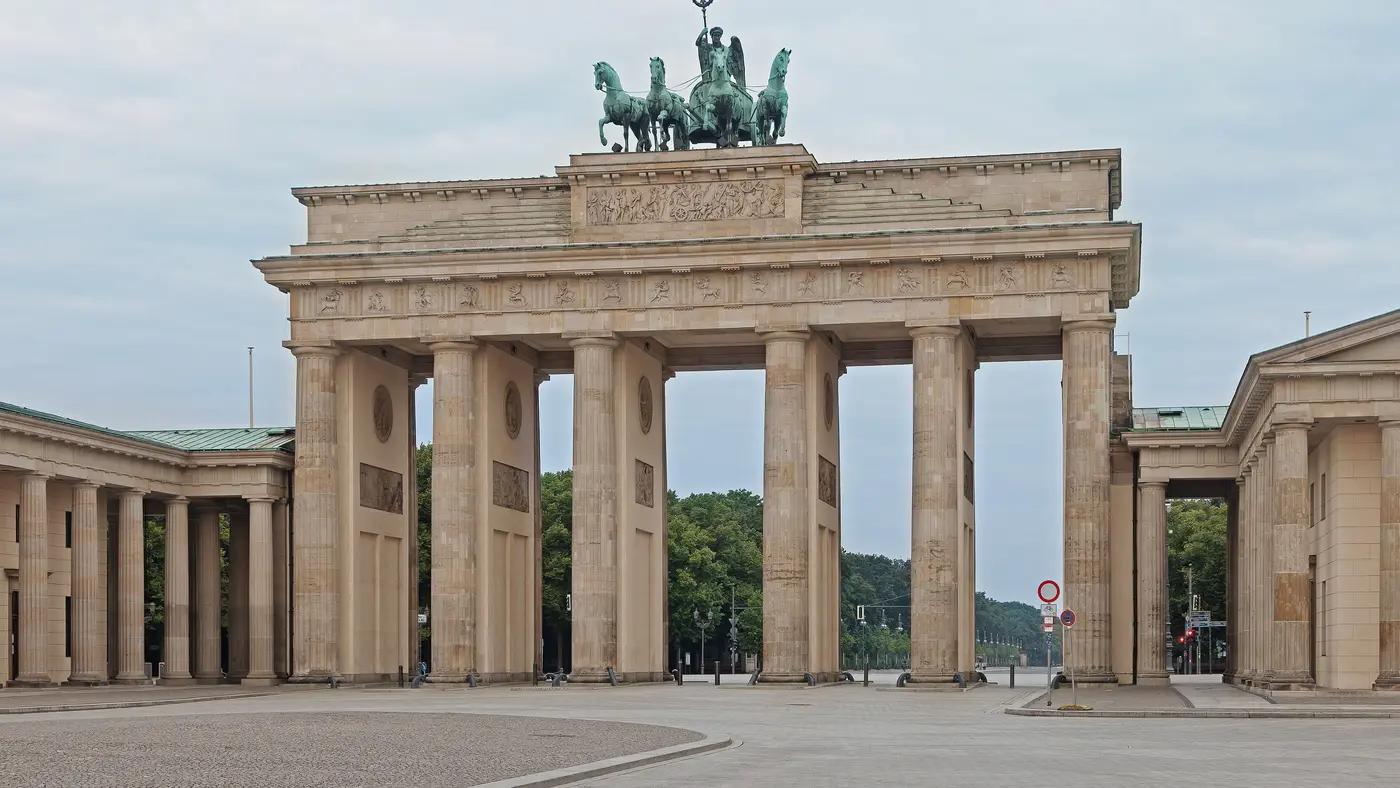
Brandenburg Gate at about km 41.8. It is the loudest point of the day, and it is not the finish.
The line is about 350 m further west on Straße des 17. Juni, and the gantry is visible the whole
way without seeming to come any closer.
Cut-offs
The time limit is 6 hours 15 minutes from crossing the start mat. The organiser’s 2027 race-day
page puts a cut-off at km 33 at 3.50pm and closes the finish at 5.15pm; in 2026 those were
3.40pm and 5pm, so check the 2027 briefing. Runners who miss the km 33 cut-off ride to the
finish in the sweep bus. With the last wave off at 10.27am, a runner in block K running an even
pace inside the time limit reaches km 33 well before 3.50pm.
At a glance
distance
42.2 km26.2 mi
Loop, asphalt
climb
35.9 m118 ft
Highest point 18 m above lowest
cut-off
6:15 h
6 h 15 min
first held
1974
Abbott World Marathon Majors
The fastest road on earth: nothing here stops you, which is exactly the problem.
The Berlin Marathon is a flat loop of 42.2 km with 35.9 m of climbing. Its lowest point is 33 m and its highest 51 m above sea level. Next race: Sunday 26 September 2027.
The Marathon Expo is in the old Tempelhof Airport, Platz der Luftbrücke 5. For 2027 the
organiser gives Thursday 23 September from 3pm to 8pm, Friday 24 September from 10am to 8pm and
Saturday 25 September from 9am to 7pm. Entry is free and bags are limited to 55 by 40 by 25 cm.
The 2027 rules for collecting numbers are not out yet. In 2026 numbers were handed out in Hangar
5, in person only and without exception, against photo ID and the start pass emailed seven to
ten days before the race. Saturday was the last day, and the organiser advised coming on the
Thursday or Friday morning, since Friday afternoon and Saturday are the busiest. There was no
collection on race morning.
The start, waves and pacers
The start area is on Straße des 17. Juni between the Brandenburg Gate and the Kleiner Stern.
Your start block is printed on your number. The organiser’s 2027 page lists six running waves:
Wave 1, blocks A, B and C: 8.45am
Wave 2, blocks D and E: 9.05am
Wave 3, blocks F and G: 9.33am
Wave 4, block H: 10.02am
Wave 5, block J: 10.12am
Wave 6, block K: 10.27am
The entrances open at 7am for blocks A to D, 7.30am for E and F, 8am for G, H and J and 8.30am
for K. These are the same wave times as in 2026, so treat them as provisional until the 2027
briefing appears. Pacers carry flags with their finish time, from 3:00 in wave 1, and in 2026
the last wave had pacers up to 6:00.
Bag drop
The clothing drop is booked at registration. Runners who booked it get a bag with their number
on it to leave at the drop-off station; everyone else has a poncho symbol on their number and
gets a poncho instead. In 2026 bags could be collected until 5.15pm on showing your number. The
2027 drop-off times and places are not published yet.
On the course
The organiser lists 15 aid stations. Water is at km 5, 12, 17.5, 22.5, 27.5, 32.5, 34.5, 38 and
km 40. Water, fruit, tea and Maurten Drink Mix are at km 9, 15, 20, 25, 30 and 36, and Maurten
Gel 100 is handed out at km 27.5. These are the 2026 positions. Behind the finish, every
finisher gets an alcohol-free Erdinger.
Trip
Getting a place
Ballot open for the 2027 race As read 24 October 2026.
Next: ballot closes, 2027 race, .
Past years and every way in
For the 2026 race it opened 25 September 2025, closed 6 November 2025 and was drawn 27 November 2025.
Brandenburg Gate. Photograph by Thomas Wolf, www.foto-tw.de, CC BY-SA 3.0
From the airport
Since December 2025 the FEX airport express runs up to four times an hour and takes about 19
minutes to Potsdamer Platz and about 23 to the Hauptbahnhof, and the hourly RE20 adds to it. The
S9 runs every 20 minutes to Alexanderplatz in about 40 minutes. VBB lists a single ticket for
zones A, B and C, the fare the airport needs, at EUR 5.00.
Where to stay
The start and finish both sit in the Tiergarten between the Brandenburg Gate and the
Siegessäule, and the stations the organiser names for the start area are Unter den Linden,
Bundestag, Brandenburger Tor, Potsdamer Platz and the Hauptbahnhof. Anywhere in Mitte or around
Potsdamer Platz or the Hauptbahnhof puts you a walk or a short ride from the start, and the last
two are also stops on the FEX from the airport.
Race-day transport and closures
The organiser asks runners to use public transport, and the race number is the ticket. The 2027
page says it is valid in fare zones A, B and C over the race weekend; in 2026 it ran from
midnight on the Thursday until 3am on the Monday after the race.
Roads close across the city on both race-weekend days. In 2026 the first closure band on the
organiser’s map started at 5am on the Saturday and again at 5am on the Sunday, and the map
showed every road free again only from 6pm on Thursday 1 October. The 2027 closure map is not
out yet.
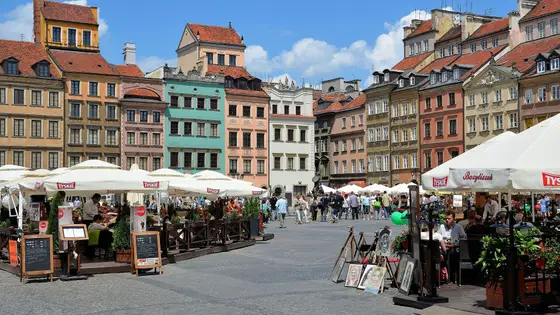
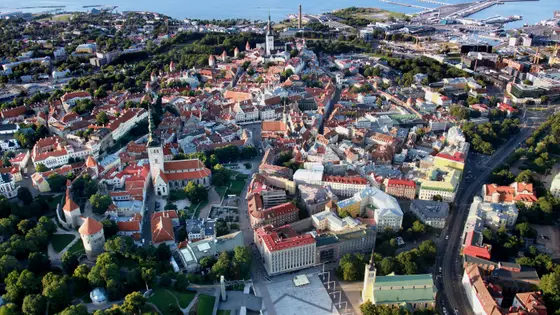
Climb summed after smoothing the heights over 1 km. The edge is this course's height profile on one scale for every race: 250 m above its lowest point fills it. Photo: Old Town Market Place, by Adrian Grycuk, CC BY-SA 3.0 pl, via Wikimedia Commons.
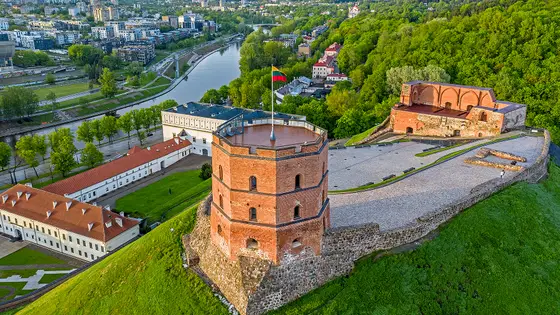
Climb summed after smoothing the heights over 1 km. The edge is this course's height profile on one scale for every race: 250 m above its lowest point fills it. Photo: Gediminas' Tower, by BigHead, CC BY-SA 4.0, via Wikimedia Commons.
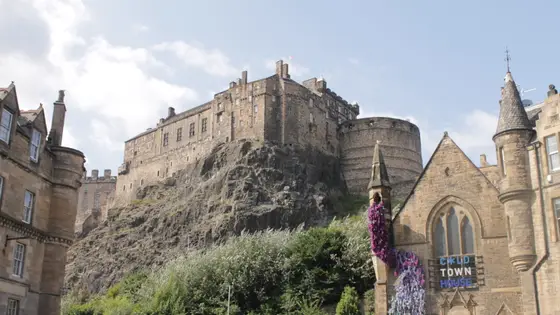
Climb summed after smoothing the heights over 1 km. The edge is this course's height profile on one scale for every race: 250 m above its lowest point fills it. Photo: Edinburgh Castle, by Stephencdickson, CC BY-SA 4.0, via Wikimedia Commons.
Climb summed after smoothing the heights over 1 km. The edge is this course's height profile on one scale for every race: 250 m above its lowest point fills it.
Climb summed after smoothing the heights over 1 km. The edge is this course's height profile on one scale for every race: 250 m above its lowest point fills it.
Questions about the Berlin Marathon
When is the Berlin Marathon 2027?
Sunday 26 September 2027, the first edition under the name Generali Berlin Marathon. The organiser's race-day page has the first running wave off at 8.45am on Straße des 17. Juni, between the Brandenburg Gate and the Kleiner Stern, and the last at 10.27am.
How do I get an entry for the Berlin Marathon 2027?
Most places go by lottery, open from 1 October to 12 November 2026, with results on 3 December 2026. The fee is EUR 215, charged only if you are drawn. Runners born in 2009 or earlier can enter. Men born between 1983 and 2009 with a marathon under 2:45 from 2025 or 2026, and women in the same years under 3:10, can apply with proof of time inside the lottery process; older age groups have slower standards. Charity partners and official travel partners also sell places.
Is the Berlin Marathon course flat?
Very nearly. Measured on Berlin's one-metre terrain model and smoothed over a kilometre, the loop climbs 35.9 m in all. Its lowest point, 33.1 m, is at about km 4.5 and its highest, 51.4 m, at about km 28.2 on Lentzeallee. The finish is less than a metre higher than the start.
9 more questions
What is the cut-off time for the Berlin Marathon?
6 hours 15 minutes from crossing the start mat. The organiser's 2027 race-day page puts a cut-off at km 33 at 3.50pm and closes the finish at 5.15pm; in 2026 those were 3.40pm and 5pm. Runners behind the cut-off leave the course and ride to the finish in the sweep bus.
Where do I collect my race number?
At the Marathon Expo in the old Tempelhof Airport, Platz der Luftbrücke 5. For 2027 it is open on Thursday 23 September from 3pm to 8pm, Friday from 10am to 8pm and Saturday from 9am to 7pm. In 2026 numbers were collected in person only, with photo ID and the start pass emailed a week or so before, and Saturday was the last chance.
How do I get from BER airport to the start?
The FEX airport express runs up to four times an hour from BER to Potsdamer Platz in about 19 minutes and to the Hauptbahnhof in about 23. Both are stations the organiser names for the start area. The S9 runs to Alexanderplatz every 20 minutes in about 40 minutes.
Is the Brandenburg Gate the finish of the Berlin Marathon?
No. The course runs through the Gate at about km 41.8, and the finish line is about 350 m further west on Straße des 17. Juni.
Does the race number work as a transport ticket?
Yes. The organiser's 2027 page says the race number is a ticket in fare zones A, B and C over the race weekend. In 2026 it was valid from the Thursday of race week until 3am on the Monday after the race.
How do I enter the Berlin Marathon?
The 2027 lottery is open. It opened on 1 October 2026, closes on 12 November and the results are due on 3 December. There are 5 ways in: Lottery, Fast runners, Charity partners, Travel packages and Jubilee Club. Entry fee: €215 (for the 2027 race). Entry details on the organiser’s site
What is the time limit at the Berlin Marathon?
Runners have 6 h 15 min to finish.
What are the course records at the Berlin Marathon?
The first Berlin Marathon was run on 13 October 1974, organised by Horst Milde. 286 runners
started, near the Mommsenstadion in the west of the city, and 244 finished. From 1975 the race
started and finished in the Mommsenstadion. It moved into the city centre in 1981, starting at
the Reichstag with 3,486 runners from 30 nations, and passed 10,000 entries for the first time
in 1985. From 1987 to 1989 it started in front of the Brandenburg Gate, and in 1990 the runners
went through the opened Gate. Since 2003 the race has started and finished between the Gate and
the Siegessäule.
The field kept growing: 27,621 entries in 1998, 34,070 finishers in 2010 and 43,990 in 2019.
There was no race in 2020. In 2024, the race’s 50th anniversary year, 54,062 runners finished,
then a world record for finishers in a marathon, since passed by New York. 2025 had 48,359
finishers, and in 2026 more than 56,000 runners from 162 nations entered the marathon. BMW’s 16
years as title sponsor ended in 2026, and from 2027 the race is the Generali Berlin Marathon.
World records have fallen in Berlin thirteen times, nine men’s and four women’s, from Christa
Vahlensieck’s 2:34:47 in 1977 to Tigist Assefa’s 2:11:53 in 2023. Ronaldo da Costa ran 2:06:05
here in 1998, Haile Gebrselassie 2:04:26 in 2007 and 2:03:59 in 2008, and Eliud Kipchoge
2:01:39 in 2018 and 2:01:09 on 25 September 2022. That last run is still the men’s course
record; the 2026 winner, Guye Adola, ran 2:02:50. Assefa came back in 2026 and won in 2:11:04, 49
seconds faster than her own world record run of 2023.