
Entry through the organiser
Entry details on the organiser’s site →
Courons MTL, a third party. We take no entries and have no part in the race.
 Marathon Trip
Your trips on every device: sign in, or make a free account when you save one.
Signed in on this browser.
Sign in My marathons Account and dataLocked out? An export link you keep still opens your list in any browser.
No account: email it to me
One email with this trip and a link to open it again. We do not keep the address and send nothing else.
Only a race from our list can be emailed. An account keeps this one.
What we keep, and what we do notCheck your inbox at to confirm it.
Browse the racesEach edition the day it comes out, and nothing else. Off again with one click. How it is kept.
A climb of 49 m from km 11 to km 17, downhill to km 25, then another climb of 50 m to km 33.
© OpenStreetMap contributors
km 0.5mile 0.3
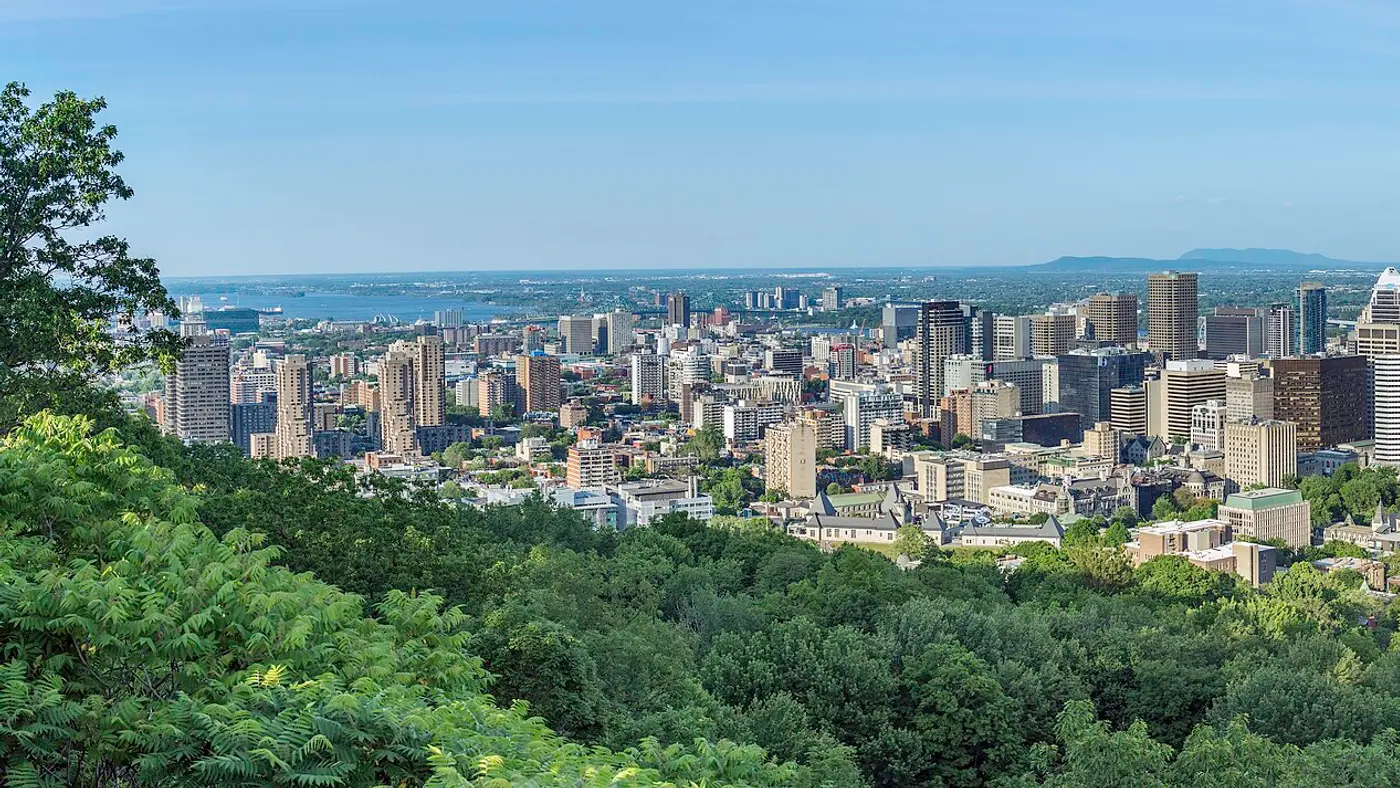
The start is in the park on Île Sainte-Hélène, in the middle of the St. Lawrence.
Photo: abdallahh from Montréal, Canada, CC BY 2.0
Height drawn many times taller than life. Heights: GEDTM30.
Dashed: bridge

Your 5 gels, at the orange marksFor a 4:00 finish, one every 40 minutes
Get them on AmazonAmazon partner link
Montreal’s course is a cross, and its hard work sits on one long street. After 8 flat kilometres on the islands and the waterfront, the road climbs, gently but almost without a break, from the Old Port to its high point at about km 16.8 on Boulevard Saint-Laurent. It then runs down Saint-Laurent to Ahuntsic in the north of the island, turns, and comes back up the same boulevard: about 46 m of climbing between km 26.5 and km 33.5, the stretch where a marathon is usually decided anyway. A runner who takes the descent to km 24 with restraint rather than racing it has something left for the return.
The race runs point to point from Parc Jean-Drapeau, on Île Sainte-Hélène in the St. Lawrence, to Parc Maisonneuve in the east of the city. The kilometres and heights below are measured along the organiser’s 2026 course line on an open elevation model. The organiser warns that its courses can change at any time, and the 2027 map has not been confirmed, so check its marathon page before you plan your pacing. The organiser’s own figures for the course, +172 m and -140 m, differ from the measured ones below.
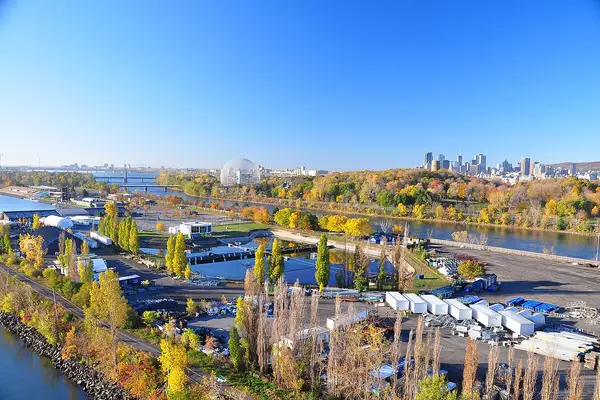
In 2026 the start was at Espace 67 on Île Sainte-Hélène. The course crosses straight onto Île Notre-Dame on the Passerelle du Cosmos and spends most of its first 3 km on the Circuit Gilles-Villeneuve. This is the lowest ground of the race: about 13 m at the start and 9.4 m at about km 1.9. The marathon and the half marathon start together.
Avenue Pierre-Dupuy and the Pont de la Concorde, from about km 3.7 to km 4.9, carry the course off the islands to the Cité du Havre. Chemin des Moulins, Rue Riverside and Rue Mill lead round to Rue de la Commune Ouest in Old Montreal at about km 7.7. These kilometres stay between 12 m and 16 m, the flattest running of the day.
The first real rise comes as Rue McGill leads up from the waterfront to Rue Notre-Dame, about 16 m in a kilometre. Notre-Dame Est passes City Hall, where in 2026 musicians of the Montreal Symphony Orchestra played on the steps. The course then works north through Rue Saint-Antoine, Rue Atateken, Rue Ontario Est and Rue Berri, climbing again from about km 11.
Rue Cherrier and Avenue du Parc-La Fontaine bring the course past Parc La Fontaine, then Rue Rachel Est, Rue Marquette and Boulevard Saint-Joseph Est lead west across the Plateau. The road rises the whole way, from about 46 m at km 12.8 to 58 m at km 15.7, and then about 13 m in the next kilometre as the course turns onto Boulevard Saint-Laurent. The high point of the race, 72.2 m, comes at about km 16.8.
Saint-Laurent runs north and downhill for 7 km, from 72 m to about 23 m by km 23.6. In 2026 the cheering station at Parc Jarry, at km 19.76, marked the 50th anniversary of the Montreal Olympics, and the half way mark falls on this descent. At about km 23.7 the course leaves Saint-Laurent for the streets of Ahuntsic, Rue Somerville, Avenue Park Stanley, Avenue Saint-Charles and Boulevard Gouin Est, where it reaches about 19 m at km 24.5. It rejoins Saint-Laurent at about km 26.6. Every metre lost here has to be climbed again.
This is the decisive stretch. The course climbs Saint-Laurent southbound from about 23 m at km 26.5 to 68.3 m at km 33.4, about 46 m in 7 km. The steepest part, about 14 m in under a kilometre, comes between about km 29.5 and km 30.4. At about km 32.2 the course turns east onto Rue Beaubien Est and zigzags across Rue Saint-Denis, Rue Saint-Hubert and Boulevard Rosemont to the second high point, 68.6 m, near km 33.5.
Boulevard Saint-Joseph Est runs east from about km 34.8 and drops to about 50 m by km 37.3. One last rise, about 11 m, comes around Rue Masson and the 16th and 18th Avenues, to about 61 m near km 39.4. From there it is downhill: Boulevard Rosemont, Rue Viau and Rue Sherbrooke Est to the finish in Parc Maisonneuve at about 43 m. The finish area hosts the prize presentation and the festivities.
Point to point from Île Sainte-Hélène's Parc Jean-Drapeau to Parc Maisonneuve across five Montreal boroughs, with the marathon field capped at 6,600 runners.
The Montreal Marathon is a hilly point-to-point course of 42.2 km with 141.1 m of climbing. Its lowest point is 10 m and its highest 72 m above sea level. Next race: Sunday 19 September 2027, starting at 07:45.
16:004:00 PM–21:009:00 PM
09:009:00 AM–22:0010:00 PM
10:0010:00 AM–17:005:00 PM
07:457:45 AM
10:4510:45 AM
Time not published
Times as published by Courons MTL, in Montreal time, checked .
The forecast for Sunday
Add to calendar .ics file, times in Montreal time
Bibs are handed out only at the Expo-Marathon at the Palais des congrès, 200 Rue Viger Ouest, downtown, and never on race morning. For 2027 the organiser’s programme lists Thursday 16 September from 4pm to 9pm, Friday 17 September from 9am to 10pm and Saturday 18 September from 10am to 5pm; the expo’s own page still says the dates are to come. Bring photo ID and the QR code you receive by email. Someone else can collect your bib with a signed authorisation, a copy of your ID and their own. Entry to the expo is free for everyone, with technical workshops and relaxing treatments from a physiotherapy partner. The organiser sends a runner’s guide with all the practical details a few weeks before the race.
The shorter races fill the days before: the Mile on the Friday evening, and the 5 km, 10 km and 1 km on the Saturday morning, all starting from Parc Maisonneuve. A marathon entry can be combined with the 5 km or the 10 km at a 15% discount.
Your corral number is printed on your bib and follows the pace you gave when you entered. Corrals open 30 minutes before the 7.45am start, and runners are asked to be in theirs about 15 minutes before it. The organiser has not published wave times for 2027. General results are ranked on chip time, so starting further back costs nothing on the clock; prize money goes only to the elite wave.
A bag check runs at the event site before the race, and you collect your things after the finish with the coupon the team gives you. The organiser has not published where or when it opens for 2027.
Aid stations on the course and at the finish serve water and electrolytes, with toilets near some of them. The organiser has not published a list of their kilometres. A squad of pacers runs at steady paces to target times, though the times are not listed yet. Timing mats give split times, and runners can be followed live on the Courons MTL app. In 2026 the city counted 21 cheering stations along the course.
Entry through the organiser
Courons MTL, a third party. We take no entries and have no part in the race.
The STM’s 747 bus links Montréal-Trudeau airport with downtown, with a stop by Berri-UQAM metro. Check fares and the current stops on the STM site before you travel; the organiser publishes no airport advice of its own.
The expo is downtown at the Palais des congrès, by Place-d’Armes metro. The start is on the islands, by Jean-Drapeau metro, and the finish is far to the east in Parc Maisonneuve, by Pie-IX metro. A base downtown or in Old Montreal puts the expo within walking distance, keeps the start a short metro ride away, and sits on the course itself between about km 7.7 and km 10. Hochelaga-Maisonneuve is the area around the finish.
The organiser and the STM both point runners to the metro: Jean-Drapeau for the start and Pie-IX for the finish. The organiser advises buying a return ticket in advance to avoid queues, and for anyone who must drive it points to booking parking near a metro station through clicknpark and finishing the trip by transit. In 2026 the STM added metro service for the day and warned of heavier crowds than usual at Jean-Drapeau, Pie-IX and Viau.
The cross-shaped course, used since 2022, is meant to keep closures and cut-off pockets to a minimum. In 2026 streets closed on the Sunday from 6.30am to 3.25pm, and drivers could cross the course at Route 136, Rue Sherbrooke, Rue Des Carrières, the Van Horne viaduct, the A-40 and the Viau bridge. Residents of a pocket of Ahuntsic between Rue Saint-Hubert and Avenue du Parc-Stanley, near Boulevard Gouin, could not drive in or out while the course was closed.
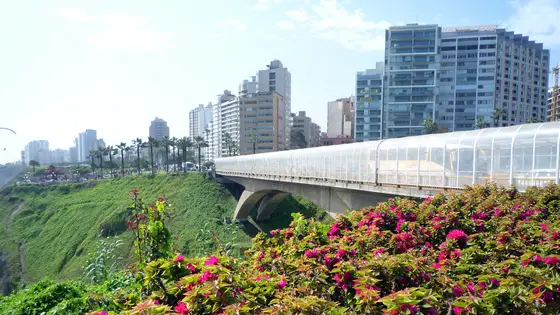
Lima, Peru
May 202742.2 kmClimb 140 m
Climb summed after smoothing the heights over 1 km. The edge is this course's height profile on one scale for every race: 250 m above its lowest point fills it. Photo: Miraflores District, by Mira4espina78y, CC BY-SA 3.0, via Wikimedia Commons.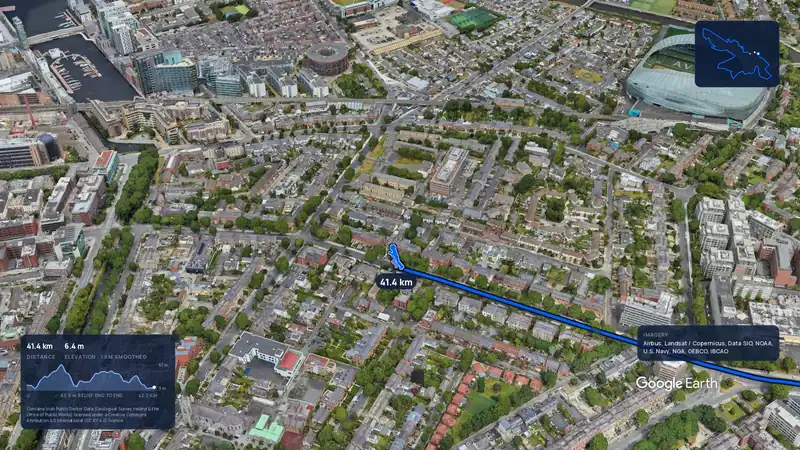 Imagery: Google Earth3:56 filmEntry closes 17 Nov
Dublin, Ireland
Sun 24 Oct 202742.2 kmClimb 142 m
Climb summed after smoothing the heights over 1 km. The edge is this course's height profile on one scale for every race: 250 m above its lowest point fills it.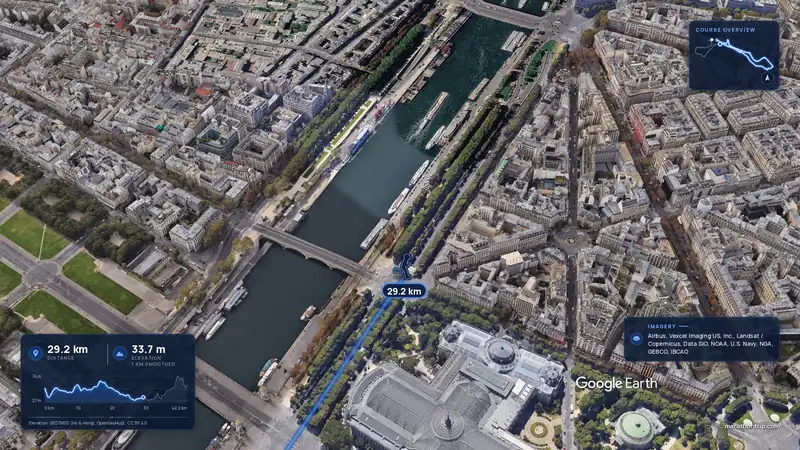 Imagery: Google Earth3:56 film
Paris, France
Sun 4 Apr 202742.2 kmClimb 142 m
Climb summed after smoothing the heights over 1 km. The edge is this course's height profile on one scale for every race: 250 m above its lowest point fills it.Sunday 19 September 2027. The marathon and the half marathon both start at 7.45am from Parc Jean-Drapeau, and the organiser notes the schedule is subject to change. The 2026 race was moved to October because Montreal hosted the UCI Road World Championships that September; 2027 is back in September.
No. Entry is first come, first served, and the price rises in steps as more people register. Once a distance is full there is no waiting list; places can only change hands through the official transfer on the Let's Do This platform. Entries are not refundable and cannot be deferred to another year.
Rolling rather than hilly. It climbs about 141 m in all, in long gradual rises. The road starts about 13 m above sea level on the island, climbs to its high point of 72.2 m at about km 16.8, drops to about 19 m by km 24.5 and climbs back to 68.6 m near km 33.5. The finish in Parc Maisonneuve is about 30 m higher than the start.
Six hours, and walkers may take part within it. The organiser says the limits are what let the streets reopen on schedule; walkers are not ranked.
Only at the Expo-Marathon at the Palais des congrès, 200 Rue Viger Ouest, on Thursday 16 September 2027 from 4pm to 9pm, Friday 17 September from 9am to 10pm or Saturday 18 September from 10am to 5pm. You need photo ID and the QR code sent by email. There is no bib pick-up on race morning.
By metro. The organiser points runners to Jean-Drapeau station for the start and Pie-IX station for the finish at Parc Maisonneuve, and suggests buying a return ticket in advance to avoid queues on the day.
Yes. The course is measured and certified by Athletics Canada, and the organiser says it lets you qualify for the Boston Marathon. General results are ranked on chip time.
No, it is a hilly course: 141.1 m of climbing over 42.2 km. The highest point is 63 m above the lowest. It finishes 30 m higher than it starts.
Runners have 6 hours to finish.
Men: 2:09:25, Gadisa Shumie, 2022. Women: 2:28:02, Salome Nyirarukundo, 2018.
About 9,000 runners took part in the first Montreal Marathon on 25 August 1979. The race disappeared from 1997 to 2002 and came back in 2004. It grew fast after that: more than 17,600 participants across all its events in 2008, 21,000 in 2010 and 32,000 in 2013. From 2012 to 2020 it ran as part of the Rock ‘n’ Roll series. In 2017 the marathon alone was cancelled because of heat and humidity, and there were no races in 2020 or 2021 because of Quebec’s pandemic restrictions.
The finish has moved with the field. It was in the Olympic Stadium until 2011, when it moved to Parc Maisonneuve because of the growing number of runners; in 2012 and 2013 it was in Parc La Fontaine. The 2026 weekend, the 34th edition, was moved to 9 to 11 October because Montreal hosted the UCI Road World Championships that September. It drew 35,000 participants from 57 countries, and the City of Montréal calls it the biggest running event in Quebec.
The course records, as listed on Wikipedia, are 2:09:25 for men, by Gadisa Shumie of Ethiopia in 2022, the first year of the cross-shaped course, and 2:28:02 for women, by Salome Nyirarukundo of Rwanda in 2018. The 2024 winners were Philemon Kiptanui of Kenya in 2:15:09 and Mélanie Desautels of Canada in 2:46:16.
Checked against these sources on .