Aid stations20 stations; 8 points on the course marked below
Each of the 20 aid stations has, in order: a medical tent with Runner Transport access, ADA and standard toilets, Gatorade Endurance Formula (lemon-lime), an announcer and water.
mile 5.7 (km 9.2)mile 5.7
waterCulligan Water Refill Station for runners' own hydration gear, sited immediately before Aid Station 4.
mile 10.1 (km 16.3)mile 10.1
waterCulligan Water Refill Station sited immediately before Aid Station 7.
mile 12.4 (km 20)mile 12.4
gelsMaurten Hydrogel Fuel Depot near Aid Station 9: Gel 100, caffeinated or non-caffeinated, 25 g carbohydrate each.
mile 15.7 (km 25.3)mile 15.7
waterCulligan Water Refill Station sited immediately before Aid Station 12.
mile 18.1 (km 29.1)mile 18.1
gelsMaurten Hydrogel Fuel Depot near Aid Station 14: Gel 100, caffeinated or non-caffeinated, 25 g carbohydrate each.
mile 20.2 (km 32.5)mile 20.2
foodChiquita Bananas begin here, at Aid Station 16, and continue through Aid Station 18 at mile 23.
mile 20.3 (km 32.7)mile 20.3
waterCulligan Water Refill Station sited immediately before Aid Station 16.
mile 21.2 (km 34.1)mile 21.2
Biofreeze Pain Relief Zone at Cermak Road and Archer Avenue: topical pain-relief spray, not a fluid or fuel stop.
Chicago has no hills to plan around, and that is not the same as having nothing to plan.
The whole loop stays inside a band of height 9.6 m tall, but it turns 36 times on the city
grid, three of those turns are near U-turns, and the field is one of the largest in the
sport: 54,383 finished in 2025. What decides the day is the speed kept through corners and
crowds, the October weather, and the one climb anyone feels, in the last kilometre.
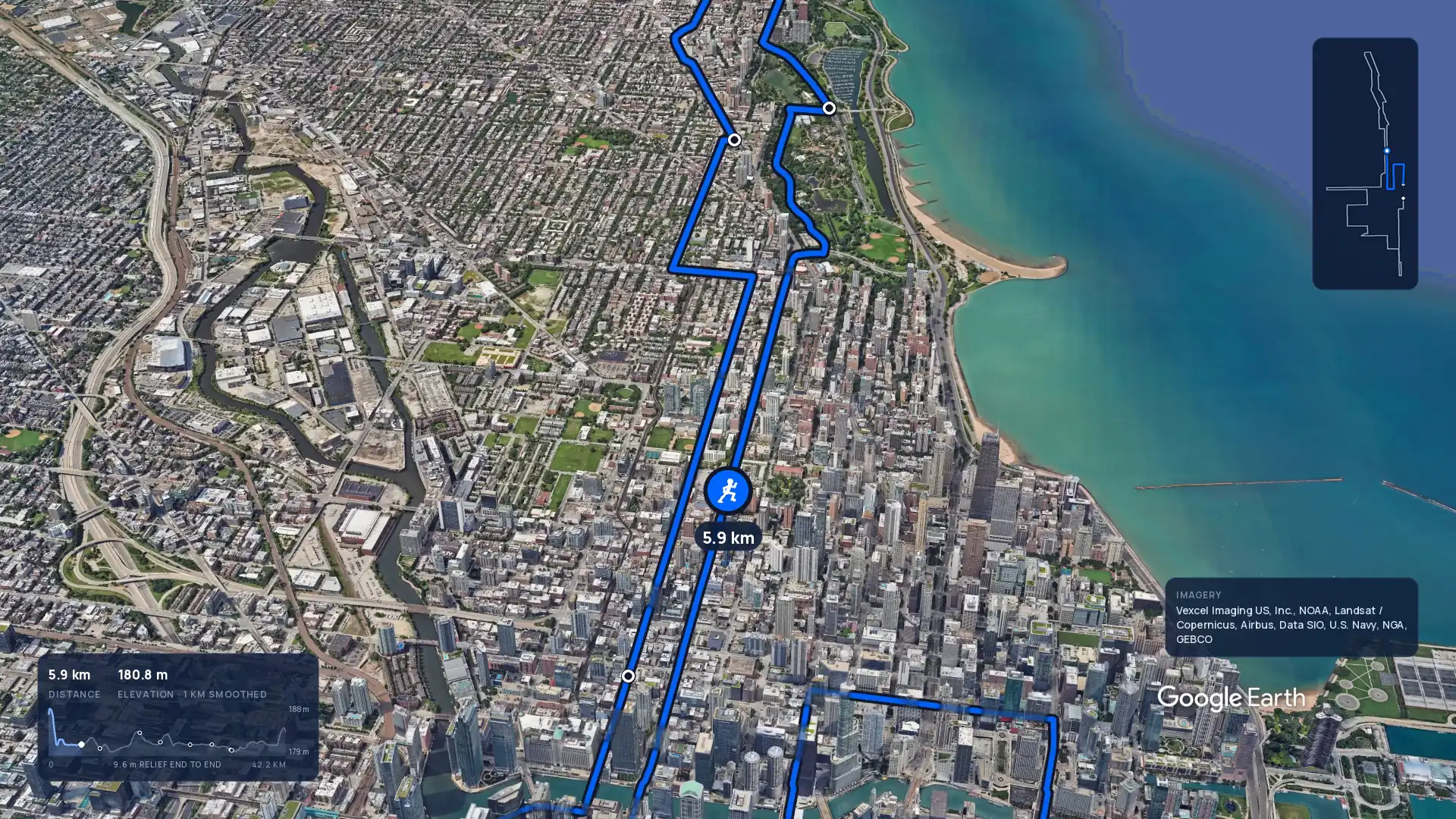
The loop starts and finishes in Grant Park, goes north, then west, then south, and comes
back up Michigan Avenue. The kilometres and heights below are measured along
the organiser’s 2026 street-closure list, walked onto OpenStreetMap, on the USGS 1 m elevation
model. The organiser has not said whether the 2027 course changes, so check its
course page before you set a
pacing plan.
Km 0 to 3.7: the Loop
km 0.0 Grant Park start
The start is on Columbus Drive in Grant Park, heading north, and the highest point of the
entire race, 188.9 m, is beside the start line at km 0.2. Columbus Drive crosses the Chicago
River before turning onto Grand Avenue at about km 1.2. Dearborn Street takes the course back
south over the river from about km 2.0 and through the Loop to Jackson Boulevard at about km
3.4. The road drops about 7 m in the first 2 km, most of the height the course has to give,
so the opening miles feel quick: hold back.
Km 3.7 to 12.8: north on LaSalle and the lakefront
LaSalle Street is the first long straight, 3.8 km from about km 3.7 to km 7.4, and the course
crosses the river again on its way north. Stockton Drive, Fullerton Drive and Cannon Drive
carry it on from about km 7.6 to km 10.1, then Sheridan Road and Inner Lake Shore Drive take
it to the northern turn at about km 12.4. The lowest point of the race is on this stretch,
179.3 m at about km 11.2. Wikipedia places this northern turn near Wrigley Field. In 2026 the first water refill
station sat at mile 5.7 (km 9.2), just before aid station 4, for runners carrying their own
soft flasks.
Km 12.8 to 21.6: back south to the river and halfway
km 21.6 Willis Tower
Broadway runs south from about km 12.8 to km 15.1, followed by Clark Street, Webster Avenue
and Sedgwick Street to North Avenue at about km 17.6. Between km 14.7 and km 15.9 the road
rises about 2.6 m, the longest steady rise before the finish and too gentle to notice. Wells
Street runs 2.6 km south, back over the river into the Loop, and halfway falls on Wacker Drive. At about km 21.6, 470 m past halfway, the course turns off Wacker onto Adams
Street at the north-west corner of Willis Tower. The organiser’s first Maurten gel depot was
at mile 12.4 (km 20.0) in 2026, near aid station 9.
Km 21.6 to 27.3: out west to the first U-turn
Adams Street is the longest straight of the middle of the race, 3.3 km west across the
river’s South Branch to Damen Avenue. At about km 24.8 the course goes a short block south on
Damen and comes straight back east on Jackson Boulevard, a turn of 182 degrees within about
200 m: the westernmost point of the loop, and the turn Wikipedia places near the United Center.
Go round it wide rather than braking into it. Extra medical tents sit between miles 14 and 15
(km 22.5 to 24.1). Jackson Boulevard then runs east to Halsted Street at about km 27.3.
Km 27.3 to 32.7: the grid, corner after corner
This is the most broken part of the course. Halsted Street south, Taylor Street west, Loomis
Street south, 18th Street east, Halsted again and 21st Street come one after another, each a
near right angle, none longer than about 1.3 km. At about km 32.7 the course leaves 21st
Street onto Canalport Avenue and into Cermak Road, a turn of 150 degrees over about 60 m and
the sharpest single corner of the race. In 2026 the second Maurten depot was at mile 18.1 (km
29.1), and bananas were handed out from mile 20.2 (km 32.5) through mile 23 (km 37.0).
Km 32.7 to 38.4: Cermak Road and the southern turn
km 32.7 Canalport Avenue into Cermak Road
Cermak Road runs east to Wentworth Avenue, past a pain-relief spray zone at Cermak Road and
Archer Avenue at mile 21.2 (km 34.1) in 2026. Wentworth Avenue and 26th Street lead to Michigan Avenue
at about km 35.8, and the course goes south to 35th Street and doubles back north on Indiana
Avenue at about km 37.3, a turn of 180 degrees. This is the southern end of the loop, the turn
Wikipedia places near Rate Field. 31st Street brings the field back onto Michigan Avenue at
about km 38.4.
Km 38.4 to the finish: Michigan Avenue and Roosevelt Road
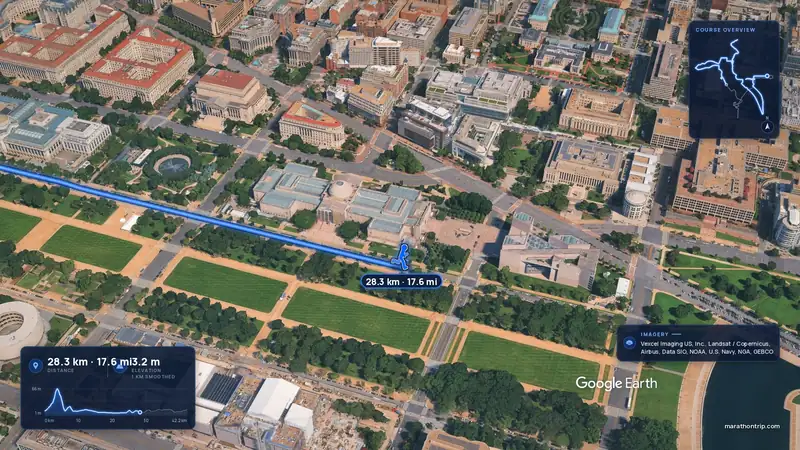
km 42.2 Grant Park finish
From km 38.4 Michigan Avenue runs 3.2 km north without a corner.
At about km 41.6 the course turns right onto Roosevelt Road, and this is the climb: on a
profile smoothed over 1 km the road gains about 4 m between km 41.2 and the line, more than
anywhere since the start, and the real ramp is shorter and steeper than that average shows.
Save something for it. The course turns onto Columbus Drive at about km 41.9 and the finish is
on Columbus Drive between 9th and 11th Street, about 330 m after that last turn.
At a glance
distance
42.2 km26.2 mi
Loop, asphalt
climb
20 m66 ft
Highest point 9 m above lowest
cut-off
6:30 h
6 h 30 min
finishers
54,383
Finishers in 2025
first held
1977
Abbott World Marathon Majors
A flat loop through 29 Chicago neighborhoods, crossing the Chicago River six times between a start and finish in Grant Park.
The Chicago Marathon is a flat loop of 42.2 km (26.2 miles) with 20 m (66 ft) of climbing. Its lowest point is 179 m (587 ft) and its highest 188 m (617 ft) above sea level. Next race: Sunday 10 October 2027.
Race week
Race week, day by day
The expo and start times below are the organiser’s 2027 schedule. Details marked 2026 may
change.
The expo and your packet
Packets are handed out only at the Abbott Health and Fitness Expo at McCormick Place: Thursday
7 October 2027 from 10am to 6pm, and Friday 8 and Saturday 9 October from 9am to 6pm. In 2026
it was in the North Building, Level 3, Hall B1, at 2301 S. Martin Luther King Drive. Bring the
Packet Pick-up email (sent at the end of September in 2026) and a government-issued
photo ID that matches the name you registered under. Every runner collects their own packet:
nobody may collect for someone else, and there is no pick-up on race day.
The free Pace Team has a booth at the expo. Pacers are allocated to start corrals, and you can
run with any pace group in your own corral.
Getting into Grant Park
Grant Park opens to runners at 5.30am, and the start corrals and gear check open at the same
time. Everyone passes a security screening before entering the park, and you may be asked to
empty bottles and containers there. Hydration backpacks and vests with bladders are not allowed
on the course. Vests with front pockets, belts, handheld bottles and soft flasks are.
Waves and corrals
Runners are put in start corrals on their expected finish time. Waves 1 and 2 are assigned on
an accepted qualifying time, and Wave 3 on the finish time you gave. The 2027 schedule:
Men’s professional wheelchair: 7.20am
Handcycles: 7.23am
Men’s and women’s professional fields: 7.30am
Wave 1: 7.35am, corrals close at 7.20am
Wave 2: 8am, corrals close at 7.45am
Wave 3: 8.35am, corrals close at 8.10am
Be in your corral about 20 minutes before it closes, the organiser advises. Times are subject
to change.
Gear check
Only the clear plastic participant bag from your packet is accepted. The colour on the top and bottom of your bib, red, blue or orange,
sends you to your gear check area. Gear check opens at 5.30am and every bag must be collected by
4pm. In 2026, bags left after that went to 720 S. Michigan Avenue, open from 5.30pm to 7pm.
On the course
There are 20 aid stations, about one to two miles apart. Each one has, in this order, a medical
tent with access to a runner transport vehicle, toilets, Gatorade Endurance Formula
(lemon-lime), an announcer and water. Medical support is at 22 places on the course in all, and
in 2026 water refill stations for runners’ own bottles sat at miles 5.7, 10.1, 15.7 and 20.3.
The organiser counts 1.7 million spectators along the course.
The cut-off
The time limit is 6 hours 30 minutes, a 15-minute mile, held by an event vehicle behind the last
starter; runners behind it move to the sidewalk as the streets reopen and may not be recorded
as official finishers. In 2026 anyone finishing after 3.30pm collected their medal in an area
just west of the finish line.
Trip
Getting a place
Ballot closed for the 2027 race Going by the dates read 17 October 2026.
Next: ballot results, 2027 race, .
Past years and every way in
For the 2026 race it opened 21 October 2025, closed 18 November 2025 and was drawn 11 December 2025.
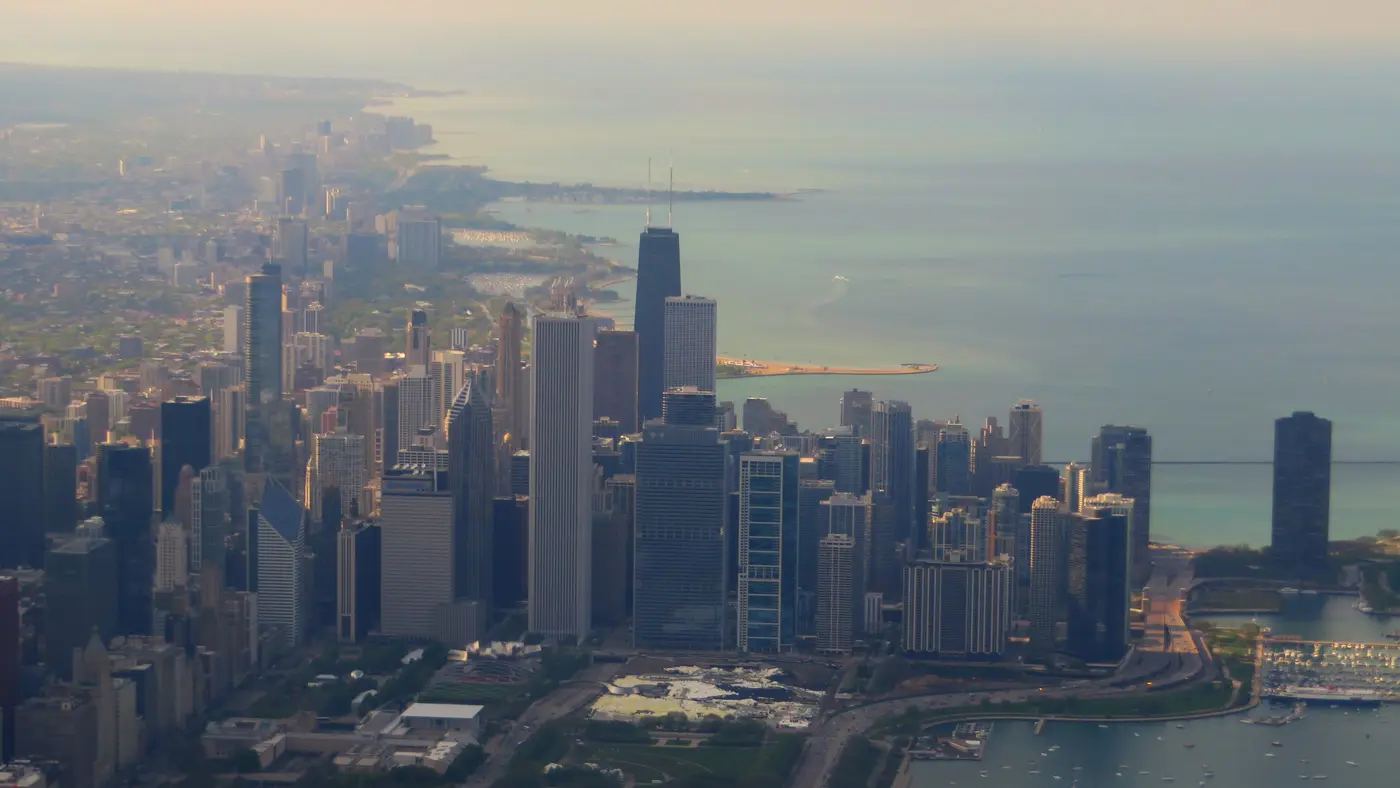
Chicago Loop. Photograph by Ken Lund from Reno, Nevada, USA, CC BY-SA 2.0
From the airport
Both airports are on the CTA train network. The Blue Line runs from O’Hare to downtown 24 hours
a day, seven days a week, and normally takes 40 to 45 minutes. The Orange Line from Midway
takes 20 to 25 minutes and runs all day except overnight, when the N62 Archer bus covers the
route.
Where to stay
The start and finish are both on Columbus Drive in Grant Park, so the Loop and the South Loop
along Michigan Avenue put a runner within walking distance on race morning, with Millennium
Park at the north end of the same stretch. The expo is 2 to 3 km south of the finish, at McCormick
Place on the Near South Side, by the Cermak-McCormick Place stop on the Green Line. Further out works
as long as it is near a train line: the organiser urges everyone to use public transport race
weekend.
Race-day transport and closures
For the expo, take the Green Line south to Cermak-McCormick Place and
walk three blocks east on Cermak Road, or the Metra Electric line, which runs frequent services
between McCormick Place and downtown; Metra sells a USD 10 weekend pass. There is a bike valet
for Divvy bikes at Michigan Avenue and Jackson Boulevard.
The 2027 closure list is not out yet. In 2026 Columbus Drive through Grant Park closed from 4am
on the Thursday until 3pm on the Monday, and the course streets closed from 6am on race day and
reopened behind the field through the afternoon. Grant Park opens to spectators at 9.30am.
Climb summed after smoothing the heights over 1 km. The edge is this course's height profile on one scale for every race: 250 m above its lowest point fills it.
Climb summed after smoothing the heights over 1 km. The edge is this course's height profile on one scale for every race: 250 m above its lowest point fills it.
Climb summed after smoothing the heights over 1 km. The edge is this course's height profile on one scale for every race: 250 m above its lowest point fills it. Photo: CN Tower, by ImagePerson, CC BY 4.0, via Wikimedia Commons.
Climb summed after smoothing the heights over 1 km. The edge is this course's height profile on one scale for every race: 250 m above its lowest point fills it.
Climb summed after smoothing the heights over 1 km. The edge is this course's height profile on one scale for every race: 250 m above its lowest point fills it.
Climb summed after smoothing the heights over 1 km. The edge is this course's height profile on one scale for every race: 250 m above its lowest point fills it.
Climb summed after smoothing the heights over 1 km. The edge is this course's height profile on one scale for every race: 250 m above its lowest point fills it.
Questions about the Chicago Marathon
When is the Chicago Marathon 2027?
Sunday 10 October 2027. It is the 49th running. The professional fields start at 7.30am in Grant Park, and the three waves of the mass field follow at 7.35am, 8am and 8.35am.
How do I get an entry for the Chicago Marathon 2027?
The application window for 2027 ran from Thursday 8 October to 2pm Central Time on Thursday 29 October 2026 and is now closed. Applicants in the drawing hear by email on Tuesday 8 December 2026 and must pay by 11.59pm on Tuesday 15 December. Places through the official charity teams, with a fundraising minimum, and through official travel partners, from 8 December, are the ways in that remain. The entry fee is USD 250 for U.S. residents and USD 260 for runners from abroad.
Is the Chicago Marathon course flat?
Yes. Measured along the walked course on the USGS 1 m elevation model, the whole race sits within 9.6 m of height, between 179.3 m at km 11.2 and 188.9 m beside the start, and climbs about 20 m in all. The last rise of note is Roosevelt Road in the final kilometre.
10 more questions
What is the cut-off time for the Chicago Marathon?
6 hours 30 minutes, a 15-minute mile pace. An event vehicle follows the last starter at that pace, and runners behind it move to the sidewalk as the streets reopen and may not be recorded as official finishers.
Where do I collect my Chicago Marathon bib?
At the Abbott Health and Fitness Expo at McCormick Place, open Thursday 7 October 2027 from 10am to 6pm and Friday 8 and Saturday 9 October from 9am to 6pm. Bring the Packet Pick-up email and a government-issued photo ID in the name you registered under. There is no pick-up on race day.
Can someone else collect my packet?
No. The organiser requires every participant to collect their own packet in person at the expo during its regular hours, and no one may collect on behalf of others.
What bag can I use at gear check?
Only the clear plastic participant bag issued with your packet. Gear check opens at 5.30am and every bag must be collected by 4pm. The colour on your bib, red, blue or orange, tells you which gear check area to use.
How do I get from the airport to downtown Chicago?
By CTA train. The Blue Line runs 24 hours a day from O'Hare and takes 40 to 45 minutes to downtown. The Orange Line from Midway takes 20 to 25 minutes and runs all day except overnight, when the N62 bus covers the route.
How do I enter the Chicago Marathon?
The 2027 drawing has closed. It opened on 8 October 2026, closed on 29 October and the results are due on 8 December. There are 7 ways in: Non-guaranteed drawing, Time qualifier, Legacy finisher, Cancelled entry, Chicago Distance Series, Charity programme and Official travel packages. Entry fee: US$250 (US$260 from abroad, for the 2027 race). Entry details on the organiser’s site
What is the time limit at the Chicago Marathon?
Runners have 6 h 30 min to finish.
How many runners finish the Chicago Marathon?
54,383 runners finished in 2025.
What are the course records at the Chicago Marathon?
The first race was run on 25 September 1977 as the Mayor Daley Marathon. More than 4,200
runners gathered at Daley Plaza and 2,128 finished. Dan Cloeter won in 2:17:52 and Dorothy
Doolittle in 2:50:47. LaSalle Bank sponsored the race from 1994 to 2007, and Bank of America
has since 2008, when the race took its current name.
The field grew to a record 33,703 finishers in 2009 and 36,088 in 2010, the year the organiser
counted more than half a million finishers since 1977. In 2025 the 47th running set a
participation record with 54,383 finishers, and Marathon Handbook counted more than 55,000
registered for 2026. Demand runs well ahead of that: more than 200,000 people applied for the
2026 race, against more than 160,000 for 2025.
The course has produced seven world records. Both course records are among them: Kelvin
Kiptum ran 2:00:35 in 2023, beating Dennis Kimetto’s 2:03:45 of 2013, and
Ruth Chepngetich ran 2:09:56 in 2024, under Tigst Assefa’s world record of 2:11:53. Neither fell
in 2026, when Amos Kipruto won the men’s race in 2:01:09 and Hawi Feysa won the women’s in
2:13:33, a second win in a row, ahead of Sharon Lokedi in 2:14:07.
October weather is the variable. The organiser’s media guide records race-day highs of 26 C
(79 F) in 2021, 12 C (54 F) in 2023, 20 C (68 F) in 2024 and 21 C (69 F) in 2025, which on a
course this flat can matter more than any hill.