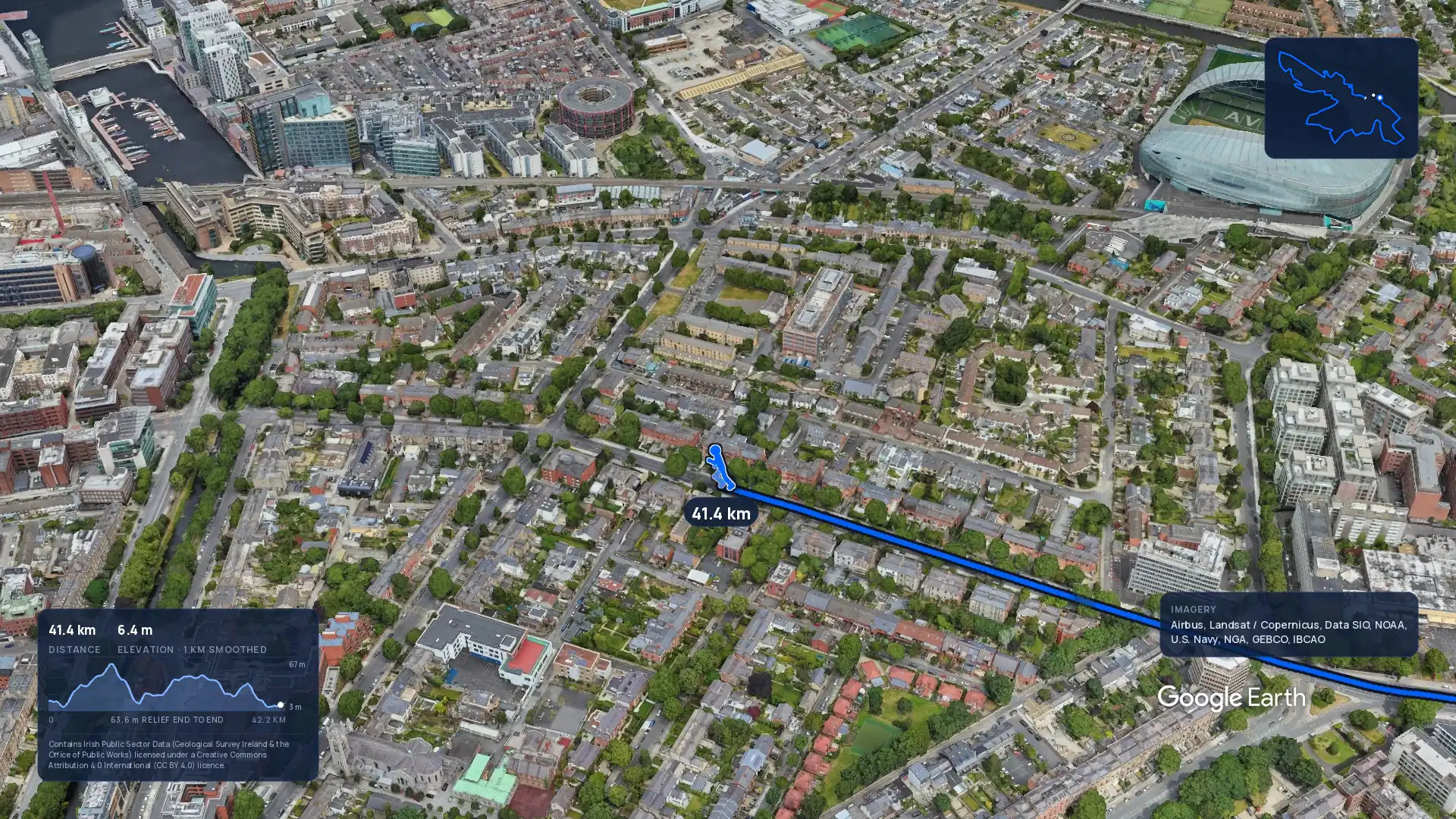
Dublin’s difficulty sits in the first half. The loop climbs 141.9 m in all, and 66.6 m of that
comes in the opening 11.3 km, on the way out to and across Phoenix Park. The second half
has one well-known hill, near km 35, and two long descents either side of it, and it ends 3 m
lower than it started. A runner who keeps something back for the first 11 km gets most of the
climbing over while still fresh, and has the drop through Milltown and the last 4 km off
Heartbreak Hill to run.
The course is one loop through the city, its northwest and its southern suburbs, starting on
Leeson Street Lower and finishing on Mount Street Upper, a few streets apart. The kilometres
and heights below are measured along the organiser’s 2026 street list, on Ireland’s lidar
elevation model. The organiser has not said whether the 2027
course changes, so check its course page
before you plan your pacing.
Km 0 to 2.6: down to the Liffey
km 0.0 The start, on Leeson Street Lower
km 1.6 Christ Church Cathedral
The start line is on Leeson Street Lower, about 60 m from St Stephen’s Green, and the organiser
calls the start downhill. The road loses 9 m in the first 2.6 km. It rounds the Green, runs
along Cuffe Street and Kevin Street into the Liberties, along Patrick Street by St Patrick’s,
and past Christ Church Cathedral at about km 1.6 before dropping down Bridge Street to the
river. The course crosses the Liffey on O’Donovan Rossa Bridge at about km 2.3, and at about km
2.6 it is at 3.3 m, the lowest point of the whole race.
Km 2.6 to 11.3: the long climb to the high point
km 5.1 Wellington Monument
km 8.1 Phoenix Monument
From the river the course climbs, with hardly a level stretch, for nearly 9 km. It follows the
north quays west (Inns Quay, Arran Quay, Ellis Quay), then turns up Blackhall Place through
Stoneybatter, Manor Street and Aughrim Street to the North Circular Road. North Road, Spa Road
and Lord’s Walk take it into Phoenix Park, which the organiser places at about km 6, and by then
the road is at about 35 m.
Chesterfield Avenue carries the course 3.4 km across the park, from about km 6.6 to km 9.9,
past the Phoenix Monument at about km 8.1, and climbs another 20 m on the way. Castleknock
Road and College Road then bring the top of the course: 66.7 m at about km 11.3. The average
gradient from the Liffey to here is under 1%, so it rarely looks like a hill, but by km 11.3
47% of the race’s climbing is done. Run it on effort rather than on the watch.
Km 11.3 to 17.4: down to Chapelizod and straight back up
The longest descent of the race follows. Tower Road, Knockmaroon Road and Upper Glen Road drop
58.5 m in about 5 km, out through Chapelizod Gate at about km 15.2 and across the Liffey again
on Anna Livia Bridge at about km 15.9. The bottom is 8.2 m, at Chapelizod, around km 16.2.
There is no recovery at the bottom. St Laurence’s Road and Sarsfield Road climb 15.3 m in the
next 1.2 km, to 23.5 m by about km 17.4. At about 1.3% that is a steeper average than
Heartbreak Hill, and it comes straight after a long downhill, when the legs least expect it.
Km 17.4 to 20.4: Kilmainham and the South Circular
km 18.6 Kilmainham Gaol
Inchicore Road passes Kilmainham Gaol at about km 18.6, and the South Circular Road runs nearly
level to Dolphin’s Barn at about km 20.4. These 3 km climb only 2 m, and they are the place to
settle before halfway.
Km 20.4 to 27.5: halfway and the long drag south
Halfway falls on Crumlin Road, which climbs 20 m between about km 20.6 and km 22.3. The road
keeps rising, more gently, along Drimnagh Road, Walkinstown Road, Cromwellsfort Road, Kimmage
Road West and Fortfield Road, another 10 m to 50.2 m at about km 27.5. That is the highest
ground of the second half.
Km 27.5 to 33: Terenure and Milltown, downhill
Templeogue Road, Terenure Road East, Orwell Road, Orwell Park, Dartry Road and Milltown Road
fall 31 m in about 5 km, to 18.8 m at about km 33.0 on Clonskeagh Road. This is the first long
descent of the back half, and the place where a runner who saved something early can start
to use it.
Km 33 to 35.4: Heartbreak Hill
Clonskeagh Road and Roebuck Road climb 19.2 m in 2.4 km, from about km 33.0 to 38.0 m at about
km 35.4. The organiser calls it the Irish Heartbreak Hill. By the numbers it is about 0.8% on
average, gentler than the climb out of Chapelizod. It hurts because it arrives at km 33, and
because it is the last one.
Km 35.4 to the finish: down to the sea and in
km 40.5 Royal Dublin Society, Ballsbridge
km 42.0 St Stephen's Church (the Pepper Canister)
km 42.2 The finish, on Mount Street Upper
From the top, Foster’s Avenue and Stillorgan Road lead over the UCD Flyover at about km 37.4 and
into Nutley Lane, which the organiser marks by RTÉ at about km 38. The road loses 34.6 m between
km 35.4 and about km 39.2, where Merrion Road is at 3.4 m. Merrion Road passes the RDS at about
km 40.5, and the course crosses Ball’s Bridge at about km 40.6, then runs along Pembroke Road and
Northumberland Road, over McKenny’s Bridge at about km 41.7, and along Warrington Place. It
rounds the Pepper Canister Church on Mount Street Crescent, and the line is on Mount Street
Upper, about 94 m beyond the church. The last 3 km climb 6.2 m in total.
The organiser’s spectator points at the finish are on Herbert Street, Stephen’s Lane, Power’s
Court and Mount Street Crescent.
At a glance
distance
42.2 km26.2 mi
Loop, asphalt
climb
141.9 m466 ft
Highest point 63 m above lowest
cut-off
7:00 h
7 hours
places
22,500
Places
first held
1980
A loop from Leeson Street Lower through Phoenix Park and the southside suburbs, including the climb runners call Heartbreak Hill near the 35 kilometre mark, back to a finish by the Pepper Canister Church on Mount Street Upper.
The Dublin Marathon is a hilly loop of 42.2 km with 141.9 m of climbing. Its lowest point is 3 m and its highest 67 m above sea level. Next race: Sunday 24 October 2027.
Race week
Race week, day by day
The race-week details for 2027 are not out yet. This is how race week ran in 2026, from the
2026 Final Instructions
and the organiser’s race-day pages. Check them again for 2027.
The expo and your race number
Numbers were collected at the expo at the RDS Simmonscourt in Ballsbridge, open from 12 noon to
7pm on the Friday and 9am to 6pm on the Saturday. Bring the e-ticket emailed to you, which
shows your wave, and photo ID, such as a passport or a driving licence. The organiser asks every runner to collect their own number in person, and collection
closes at 6pm on the Saturday, so a Sunday-morning arrival in Dublin means no race. The timing
chip is on the back of the number, and the back also has space for your medical details. The
expo is also where you can meet the pacers, and where you get the clear plastic bag you will
need for the bag drop.
On the Saturday morning in 2026 there was a 5 km shakeout run in Phoenix Park at 9am, a paid
extra at EUR 20.
Waves and the start
Waves are allocated on the finish time you gave when you entered, and in 2026 no wave changes
were allowed. The colour of your number is your wave. The 2026 start times were:
Wheelchair: 8.40am
Wave 1 (orange): 8.45am
Wave 2 (green): 9.05am
Wave 3 (blue): 9.25am
Wave 4 (purple): 9.45am
The organiser asked runners to arrive by 8am and to be in their start zone by 8.30am, and said
the wave times may change.
Bag drop
Four baggage areas, one per wave colour, sat on Merrion Square North, a short walk from the
start. Only the clear plastic bag handed out at the expo is accepted, and every bag is checked.
In 2026 they opened and closed by wave: orange 7.15 to 8am, green 7.35 to 8.20am, blue 7.55 to
8.40am and purple 8.05 to 9am. The family meeting area after the race is next to the baggage
areas at Lincoln Place.
The cut-off
The course stays open for seven hours from the moment the last runner crosses the start line.
Anyone still out after that is asked to move onto the footpath so the roads can reopen. With the
last wave off at 9.45am, even a runner in wave 4 has the full seven hours.
Trip
Getting a place
Ballot dates published for the 2027 race As read 28 October 2026.
Dublin Marathon Group, a third party. We take no entries and have no
part in the race.
Getting there and where to stay
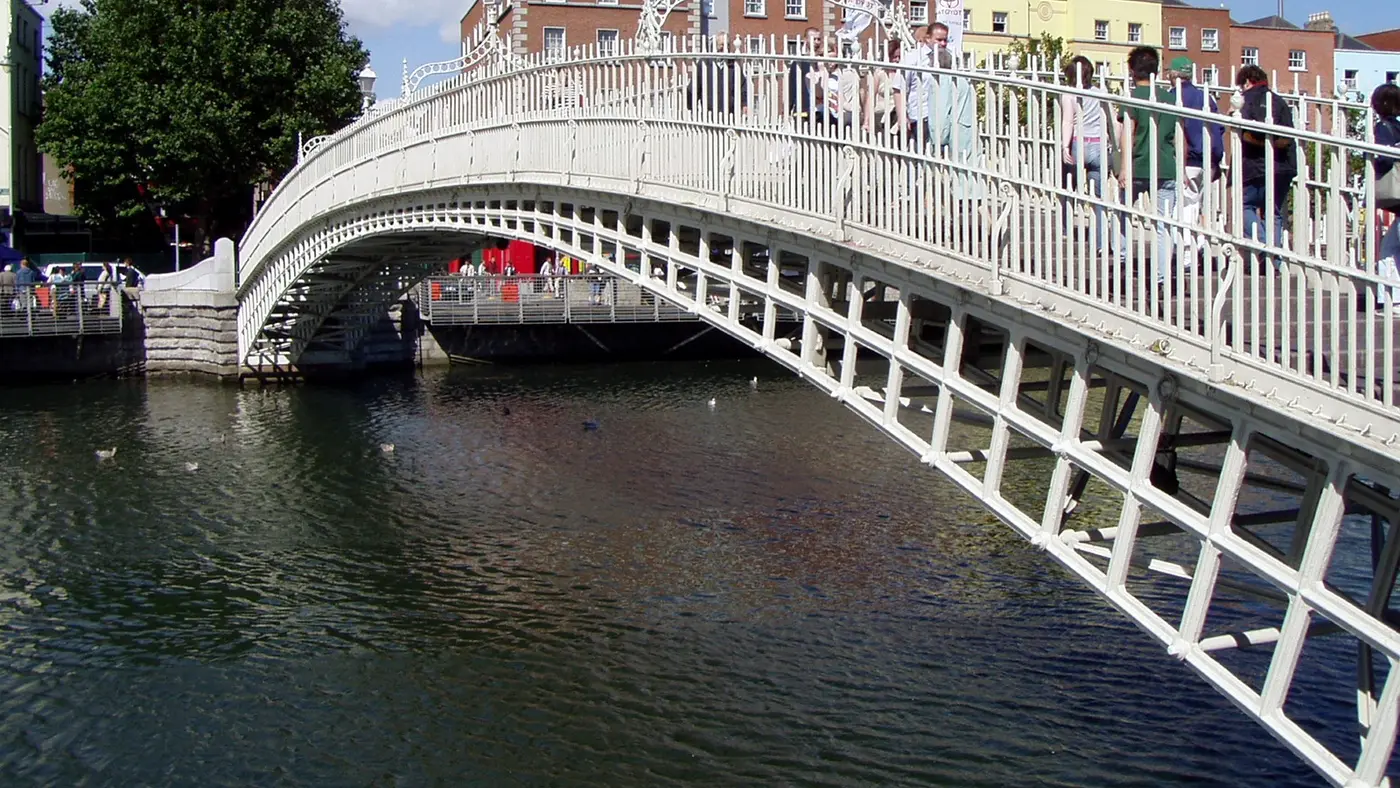
Ha'penny Bridge. Photograph by Thpohl (Wikimedia Commons), Public domain
From the airport
Aircoach route 700 runs from Dublin Airport around the clock, up to every 15 minutes, and takes
between 20 and 40 minutes to the city. Its city stops include O’Connell Street, Kildare Street
and Leeson Street Lower, which is the start street itself. The express 700X skips Kildare
Street and Leeson Street, so check which coach you board.
Where to stay
The start, the bag drop and the finish all sit in the streets around St Stephen’s
Green, Merrion Square and Mount Street, so anywhere within walking distance of that triangle
spares you the race-morning transport question entirely. Ballsbridge is the other obvious base:
the expo is there, the course passes the RDS at about km 40.5, and the finish is 1.6 km further
along the course from Ball’s Bridge. The organiser points visitors to
Visit Dublin for accommodation.
Race-day transport and closures
Major roads close across Dublin city and county on race day, from early morning until late
evening, and in 2026 some closed from the Friday for setting up. The full list is on the
organiser’s road closures page.
On the Luas, the Green Line is the one for runners: Dawson, St Stephen’s Green and Harcourt
Street are each a few minutes’ walk from the start and finish. In 2026 both lines started their
Sunday service at 7am, and the Red Line did not run between Heuston and Connolly from about
8.45am to 10.45am while the race passed. Dublin Bus runs diversions and changed timetables over the race weekend. In 2026 the race
fell on a bank holiday weekend, and the organiser warned of disruption to Irish Rail services
for that reason. Parking is prohibited near the start and finish.
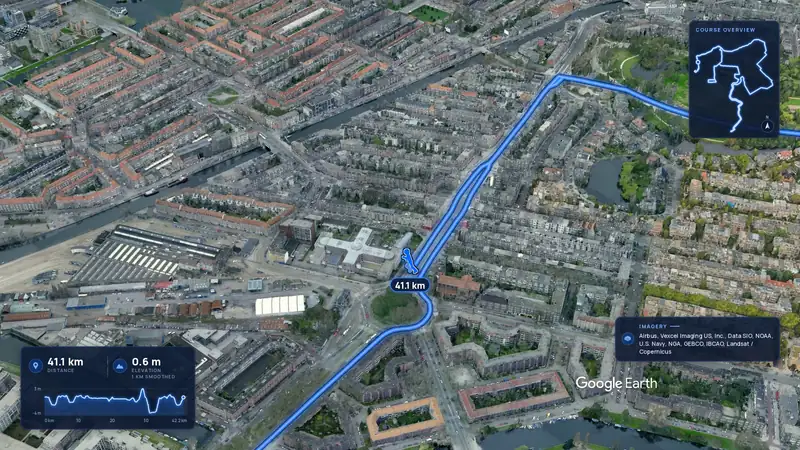
Climb summed after smoothing the heights over 1 km. The edge is this course's height profile on one scale for every race: 250 m above its lowest point fills it.
Climb summed after smoothing the heights over 1 km. The edge is this course's height profile on one scale for every race: 250 m above its lowest point fills it.
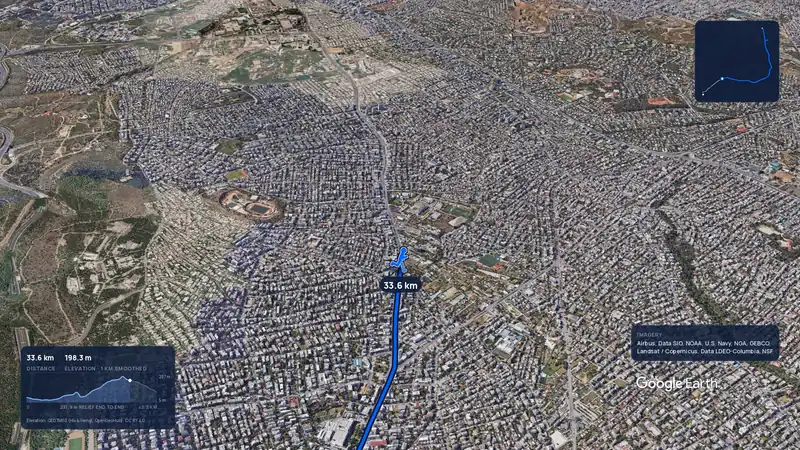
Climb summed after smoothing the heights over 1 km. The edge is this course's height profile on one scale for every race: 250 m above its lowest point fills it.
Climb summed after smoothing the heights over 1 km. The edge is this course's height profile on one scale for every race: 250 m above its lowest point fills it.
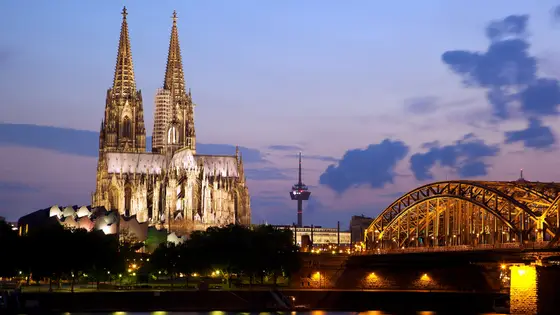
Climb summed after smoothing the heights over 1 km. The edge is this course's height profile on one scale for every race: 250 m above its lowest point fills it. Photo: Cologne Cathedral, by Jiuguang Wang, CC BY-SA 2.0, via Wikimedia Commons.
Climb summed after smoothing the heights over 1 km. The edge is this course's height profile on one scale for every race: 250 m above its lowest point fills it. Photo: Mount Royal, by Wilfredor, CC0, via Wikimedia Commons.
Climb summed after smoothing the heights over 1 km. The edge is this course's height profile on one scale for every race: 250 m above its lowest point fills it. Photo: Miraflores District, by Mira4espina78y, CC BY-SA 3.0, via Wikimedia Commons.
Climb summed after smoothing the heights over 1 km. The edge is this course's height profile on one scale for every race: 250 m above its lowest point fills it. Photo: Alexander Nevsky Cathedral, by Plamen Agov ( user:MrPanyGoff ), CC BY-SA 4.0, via Wikimedia Commons.
Questions about the Dublin Marathon
When is the Dublin Marathon 2027?
Sunday 24 October 2027. It is the 46th running of the race, and the first wave starts at 8.45am on Leeson Street Lower, by St Stephen's Green.
How do I get an entry for the Dublin Marathon 2027?
Most places go by public ballot: 17,200 of the 22,500. The ballot is open from 9am on Thursday 12 November 2026 to midnight on Tuesday 17 November 2026, results come from Wednesday 25 November, and a successful entry must be paid by midnight on Monday 30 November. Entry costs EUR 130 plus platform and payment fees. The EUR 4 ballot fee is refunded automatically if you are not drawn and taken off the entry price if you are. Charity places open from Monday 26 October 2026, and Good for Age applications run from 7 to 26 May 2027.
Is the Dublin Marathon course flat?
Not quite. It climbs 141.9 m in all, and the high point, 66.7 m, comes early, at about km 11.3. The climb runners call Heartbreak Hill rises 19.2 m between about km 33.0 and km 35.4. After that the road falls to 3.4 m by about km 39.2 and only 6.2 m of climbing remain. The finish is 3 m lower than the start.
8 more questions
What is the cut-off time for the Dublin Marathon?
Seven hours. The course stays open for seven hours from the moment the last runner crosses the start line, and anyone still out after that is asked to move to the footpath so the roads can reopen.
How do I get to the start of the Dublin Marathon?
The start is on Leeson Street Lower, a few streets from Merrion Square, where the bag drop is. The Luas Green Line stops at Dawson, St Stephen's Green and Harcourt Street, each a few minutes' walk from the start and finish, and in 2026 both Luas lines began their Sunday service at 7am. Parking is prohibited around the start and finish. In 2026 the organiser asked runners to arrive by 8am.
Where do I collect my race number?
In 2026 numbers were handed out at the expo at the RDS Simmonscourt in Ballsbridge, on the Friday from 12 noon to 7pm and the Saturday from 9am to 6pm. You collect your own number in person, with the e-ticket emailed to you and photo ID. There is no number on race morning: collection closes at 6pm on the Saturday.
Where is Heartbreak Hill on the Dublin Marathon course?
On Clonskeagh Road and Roebuck Road, from about km 33.0 to its top at about km 35.4. It climbs 19.2 m over 2.4 km, a gentle gradient that hurts because of where it comes. It is the last climb of the race.
Can I change my start wave?
For 2026 the organiser allocated waves on the finish time you gave when you entered and said no wave changes are allowed. Your wave is the colour of your race number.
How do I enter the Dublin Marathon?
The dates for the 2027 ballot are out. It opens on 12 November 2026, closes on 17 November and the results are due on 25 November. There are 4 ways in: Ballot, Good for Age, Run for a charity and Official travel packages. Entry fee: €130 (for the 2027 race). Entry details on the organiser’s site
What is the time limit at the Dublin Marathon?
Runners have 7 hours to finish.
Is there a video of the Dublin Marathon course?
Yes. A 3D flyover film of the whole course, start to finish (3:56), plays at the top of this page.
The first Dublin Marathon, in 1980, was organised by a group led by Noel Carroll. 2,100 people
took part and 1,420 finished. Dick Hooper won in 2:16:14 and Carey May in 2:42:11. The race
grew steadily, to 8,700 runners in 1988 and 11,000 in 2007, and 19,500 finished in 2016, the
year it moved from the October bank holiday Monday to a Sunday. The 2020 and 2021 races were
cancelled because of the coronavirus pandemic.
Entry by public ballot is recent. 2026 was the first year all general places were drawn, with
about 47,000 applications for 17,200 places, and the 45th running that October set a record
for finishers, beating the record set in 2025. For 2027 the general entry fee rose to EUR 130
from EUR 110, the first increase in five years.
The course records are both Ethiopian: Kemal Husen ran 2:06:52 in 2023, and Asmarech Nega
2:24:13 in 2024. Neither fell in 2026, when Abay Alemu Lesa won the men’s race in 2:10:28 and
Zenebu Jebesa won the women’s in 2:24:26, 13 seconds outside Nega’s record. Hugh Armstrong
(2:14:51) and Judith Storm (2:35:46) were the Irish champions.