Photo: Bernard Spragg. NZ from Christchurch, New Zealand, CC0
Photo: Bernard Spragg. NZ from Christchurch, New Zealand, CC0
Photo: Darius Family, CC BY 2.0
Photo: cogdogblog, CC BY 2.0
Photo: Scott Cresswell from Melbourne, Australia, CC BY 2.0
Photo: Bernard Spragg. NZ from Christchurch, New Zealand, CC0
Photo: Donaldytong, Public domain
Photo: Donaldytong, Public domain
km 0.7mile 0.5
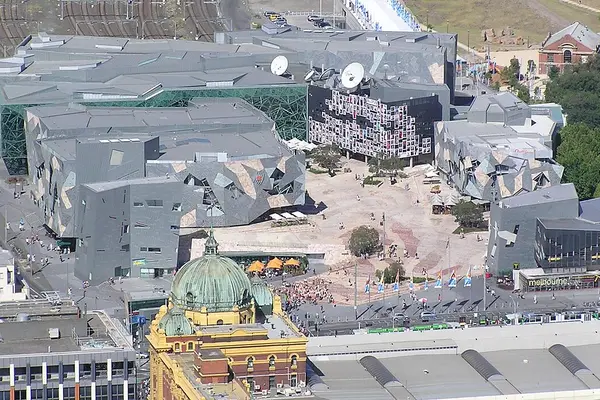
Federation Square
Federation Square, opened in 2002, faces Flinders Street Station across Swanston Street. The course runs past its Flinders Street side at km 0.73 going west and km 40.23 coming back east.
Photo: Donaldytong, Public domain
km 0.9mile 0.6
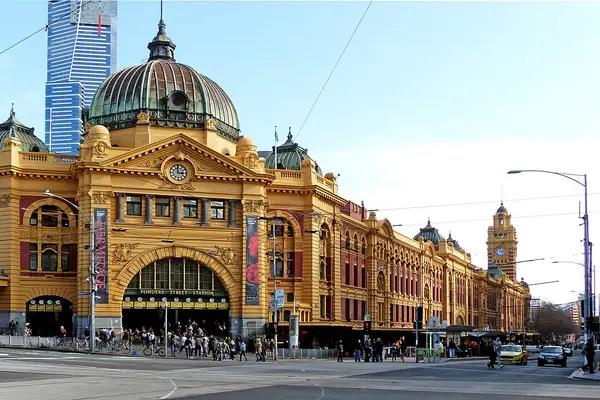
Flinders Street Station
Flinders Street Station, Melbourne's main railway station, stands on the corner of Flinders and Swanston Streets, where Australia's first city railway station opened in 1854.
Photo: Bernard Spragg. NZ from Christchurch, New Zealand, CC0
km 1.1mile 0.7
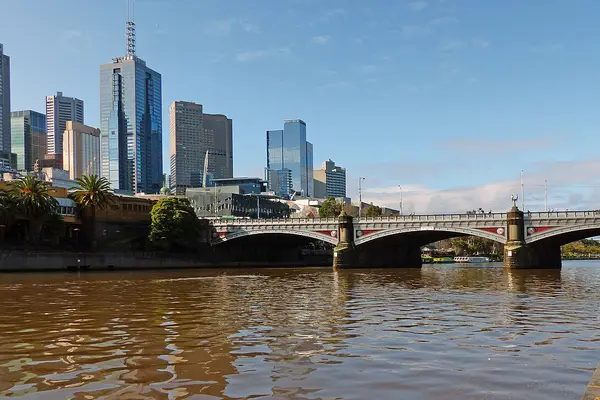
Princes Bridge over the Yarra
Princes Bridge carries Swanston Street and St Kilda Road over the Yarra River; the present bridge opened in 1888. The course crosses it twice, south at km 1.01-1.13 and north at km 39.82-39.93, on the east and west halves of the deck.
Photo: Bernard Spragg. NZ from Christchurch, New Zealand, CC0
km 1.1mile 0.7
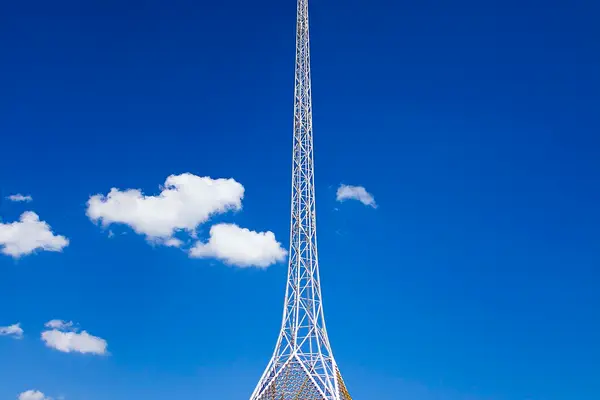
The Arts Centre spire
The spire over Arts Centre Melbourne's theatres, at the south end of Princes Bridge on St Kilda Road. The course passes under it going south at km 1.15 and coming north at km 39.79.
Photo: Darius Family, CC BY 2.0
km 2.4mile 1.5
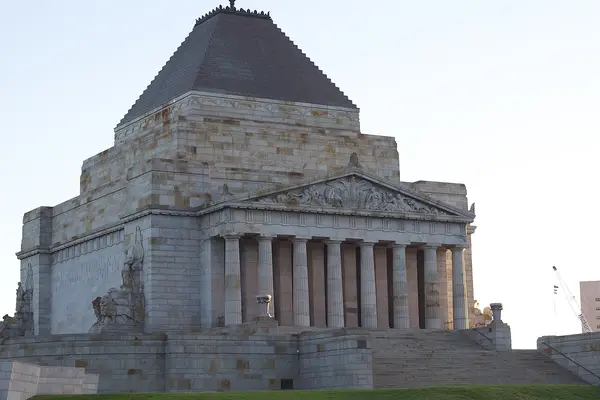
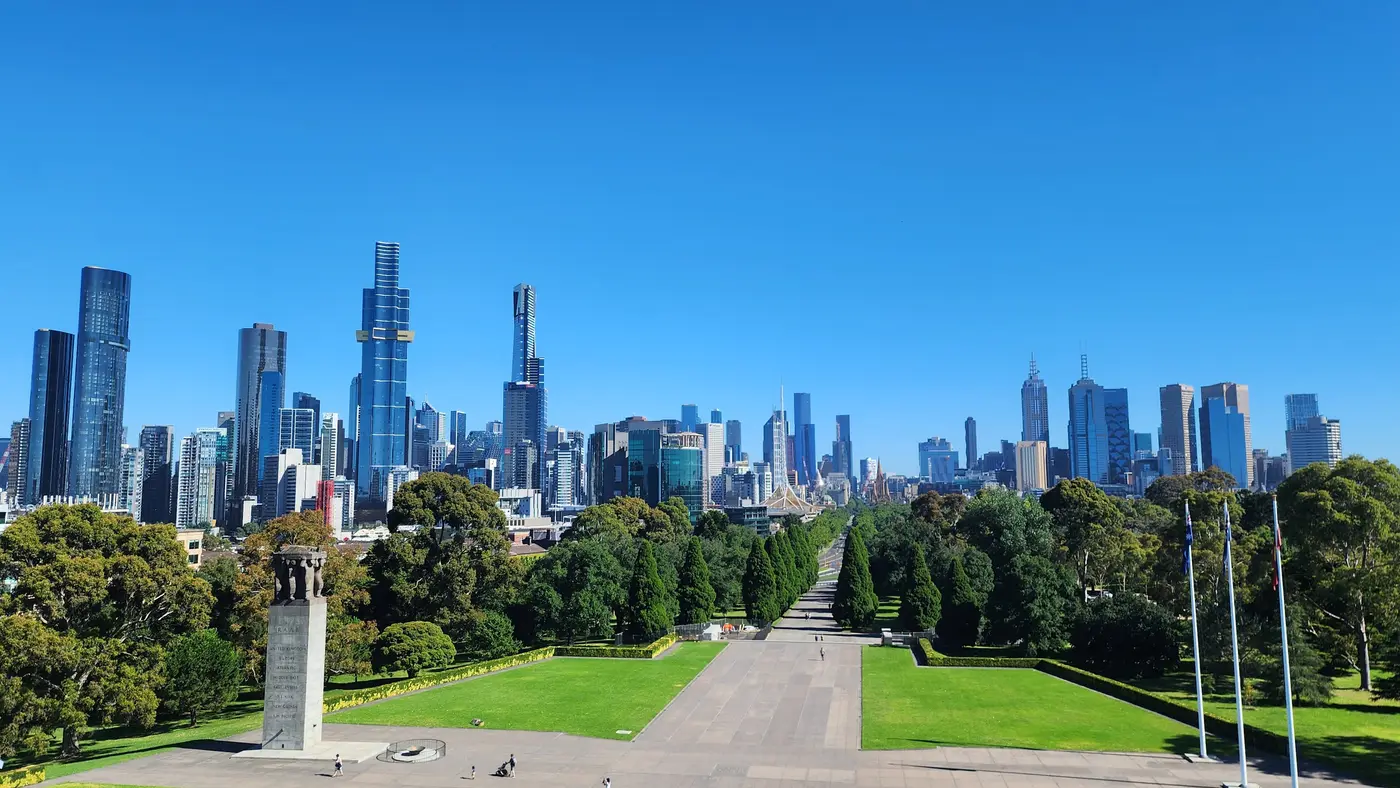
The Shrine of Remembrance
The Shrine of Remembrance, Victoria's war memorial, opened in 1934 at the top of the lawns that run down to St Kilda Road.
Photo: cogdogblog, CC BY 2.0
km 6.9mile 4.3
St Kilda beach and the Sea Baths
The St Kilda Sea Baths on the beach at the foot of Fitzroy Street, where the course turns onto the bay road.
km 7.4mile 4.6
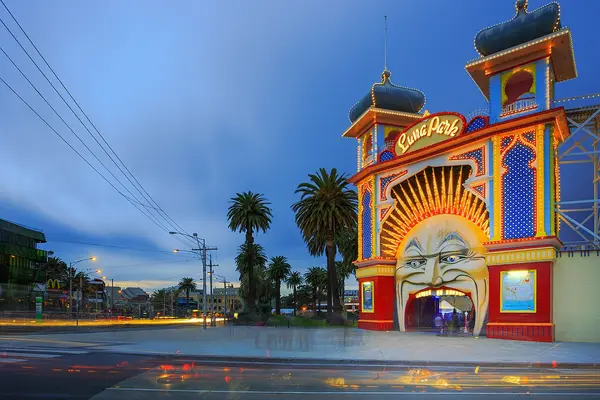
Luna Park, St Kilda
Luna Park, the St Kilda amusement park that opened in 1912, with the Palais Theatre beside it.
Photo: Scott Cresswell from Melbourne, Australia, CC BY 2.0
km 13mile 8.1
The U-turn at Brighton
The course turns round on the Esplanade at Brighton, just past Park Street, at km 12.96: the far end of the bay leg. The Middle Brighton Baths are 173 m off the line at km 13.43.
Photo: Bernard Spragg. NZ from Christchurch, New Zealand, CC0
km 21.8mile 13.6
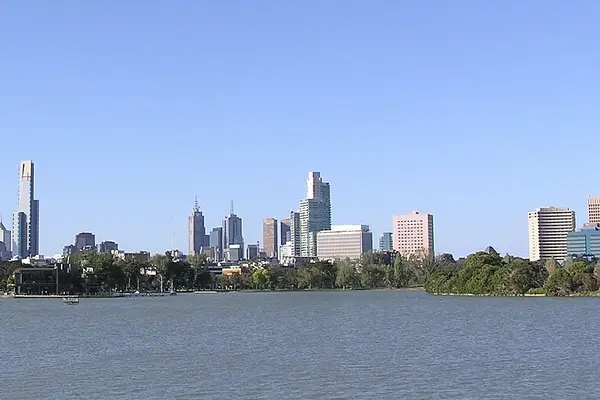
Beaconsfield Parade and the Kerferd Road Pier
Beaconsfield Parade runs along Middle Park and Albert Park beaches with the city's towers across the water to the north; the Kerferd Road Pier goes out into the bay from it.
km 33.5mile 20.8
Albert Park Lake
Albert Park Lake, which the course circles from km 27.3 to 35.1: Lakeside Drive in, Ross Gregory Drive, the Aughtie Drive hairpin, the west side past the Melbourne Sports and Aquatic Centre and Lakeside Stadium, across the top and down the east side on Lakeside Drive.
Photo: Donaldytong, Public domain
km 42.2mile 26.2
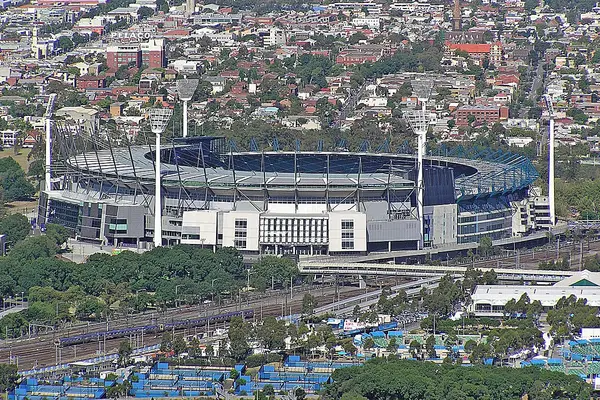
The finish inside the Melbourne Cricket Ground
The Melbourne Cricket Ground, home of cricket in Melbourne since 1853. The runners come down Barassi Way, go in through the south-west stand at km 41.82 and run anticlockwise round the south and east of the arena to the finish on the north side: about half the oval, not a lap.
Photo: Donaldytong, Public domain
Height drawn many times taller than life. Heights: GEDTM30.
0 10 20 30 40 km
0 10 20 26.2 mi
Dashed: bridge
downhill to 23
slow rise to 27
flat home
Your 5 gels, at the orange marksFor a 4:00 finish, one every 40 minutes
Flinders Street Station, Melbourne's main railway station, stands on the corner of Flinders and Swanston Streets, where Australia's first city railway station opened in 1854.
Albert Park Lake, which the course circles from km 27.3 to 35.1: Lakeside Drive in, Ross Gregory Drive, the Aughtie Drive hairpin, the west side past the Melbourne Sports and Aquatic Centre and Lakeside Stadium, across the top and down the east side on Lakeside Drive.
The Melbourne Cricket Ground, home of cricket in Melbourne since 1853.
The finish
0.0 km0.0 mi
Km by km
The short answer: an October Sunday, a field capped at 20,000, and almost nothing to climb. On
the 2026 course the whole 42.2 km stays within 14.1 m of one height, and the hill that used to
wait at 36 km is gone. What makes Melbourne hard is everything around the running: a 06:15
start, three U-turns, and getting a place at all, since general entry goes by ballot and the
2026 draw had more than 52,000 names in it for the marathon and half together.
The organiser rebuilt the race for 2026 and has not yet published a 2027 date or course, so the
details that follow are the 2026 ones.
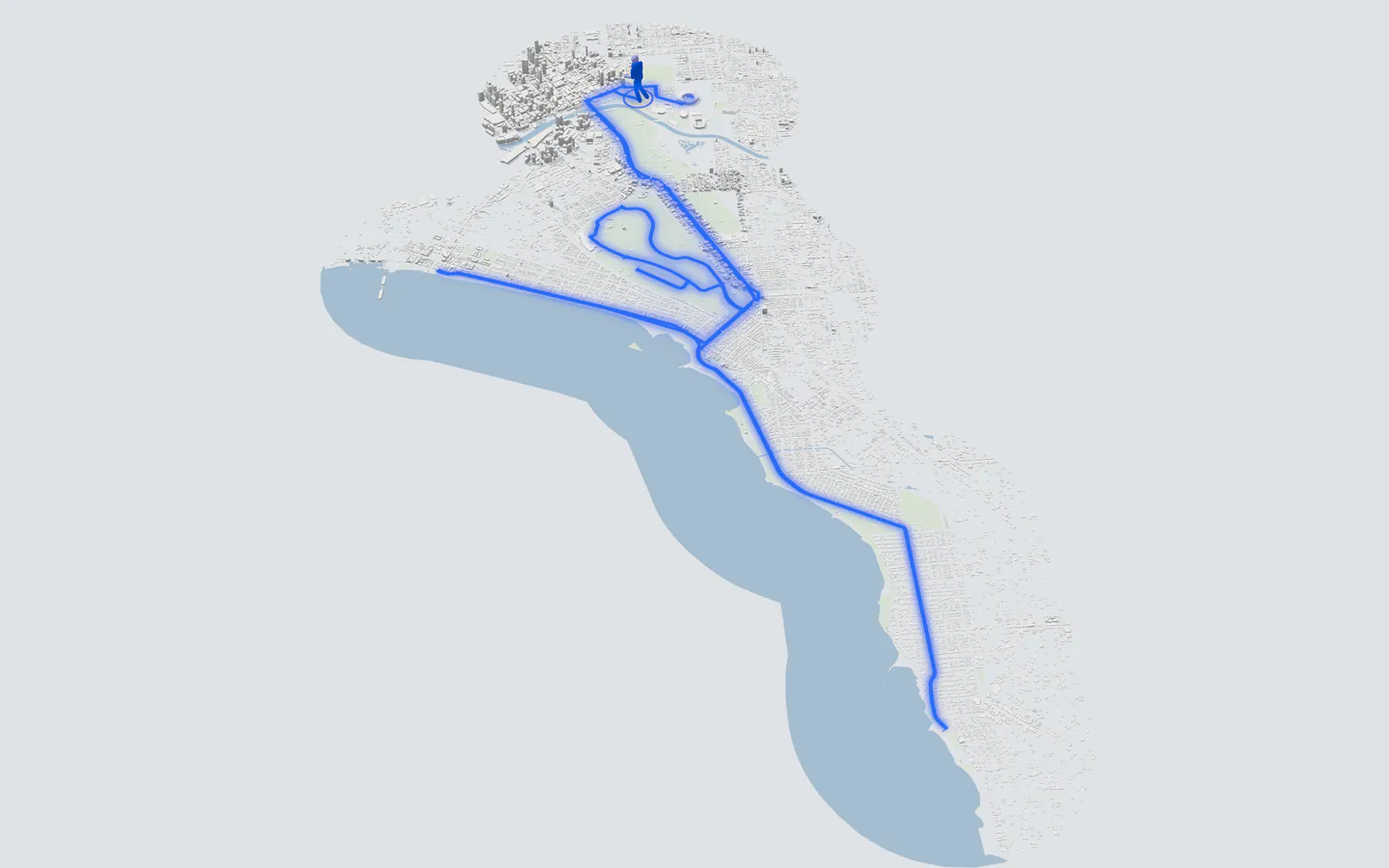
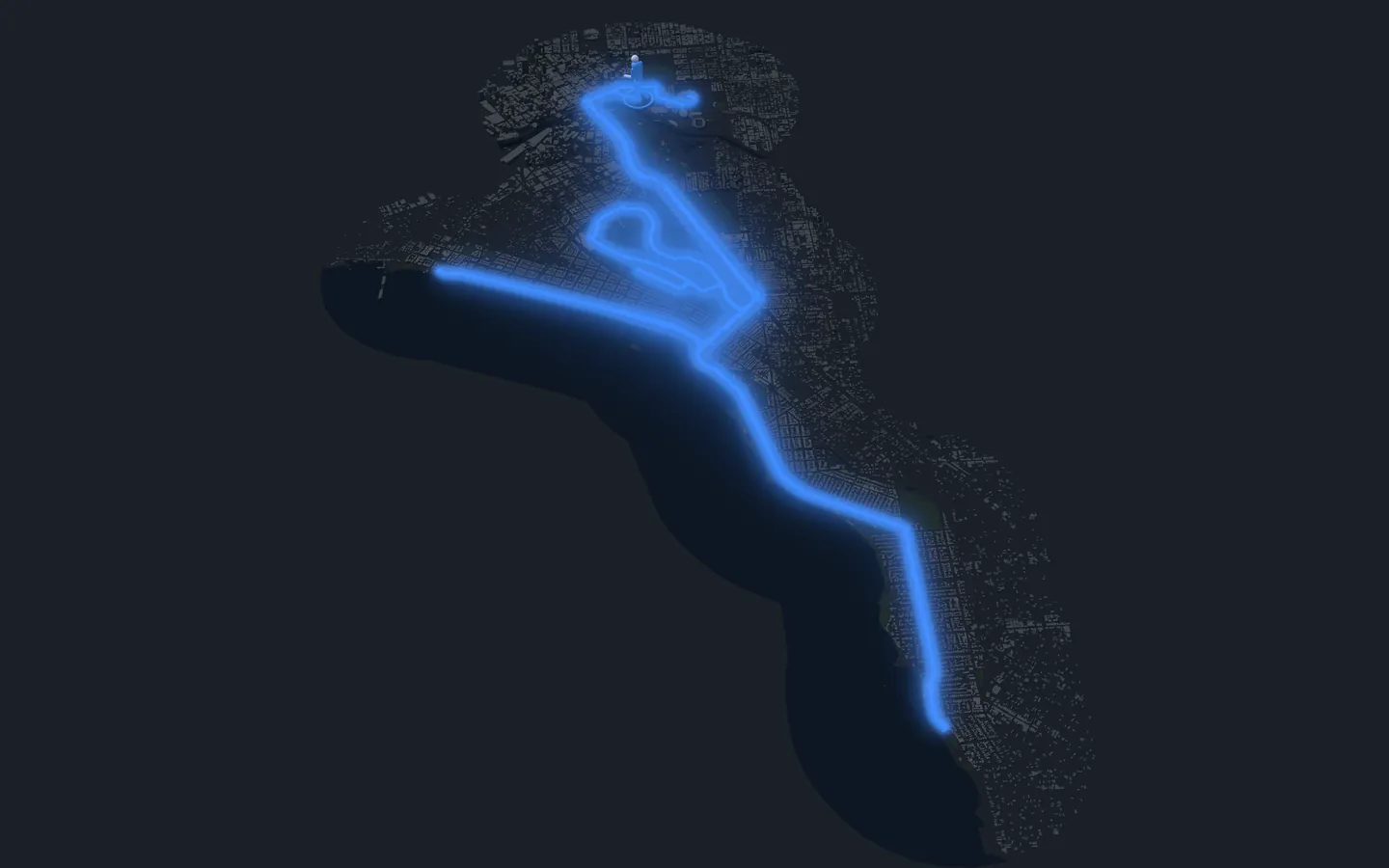
The 2026 course turned the old route round. In the organiser’s words, the marathon “now runs in
reverse direction to Beach Rd”, with up to 20% less elevation gain, about 30% fewer turns, and
the climb from Birdwood Avenue to Domain Road at 36 km taken out. The result is a loop with
three out-and-backs: south along the bay to Brighton, north-west to Port Melbourne, and a
hairpin inside Albert Park, before St Kilda Road brings you home.
Km 0 to 5.5: Batman Avenue to St Kilda Junction
km 1.1 Princes Bridge over the Yarra
km 1.1 The Arts Centre spire
km 2.4 The Shrine of Remembrance
Km 0.7 Federation Square
Photo: Donaldytong, Public domainKm 0.9 Flinders Street Station
Photo: Bernard Spragg. NZ from Christchurch, New Zealand, CC0
The start is on Batman Avenue, near the MCG and Rod Laver Arena, at 9.0 m. The first
kilometre crosses the railway on a deck, turns west along Flinders Street past Federation
Square (km 0.4 to 0.9), drops down Swanston Street and crosses the Yarra on Princes Bridge at
km 1.0. Then St Kilda Road runs straight south for 4.4 km on its east carriageway, past the
Shrine, easing down from 12.7 m at km 1 to about 10 m at km 4. Straight and slightly downhill,
it is an easy place to go out too fast in a mass start.
Km 5.5 to 7.4: the rise, then down to the water
km 6.9 St Kilda beach and the Sea Baths
Km 7.4 Luna Park, St Kilda
Photo: Scott Cresswell from Melbourne, Australia, CC BY 2.0
At St Kilda Junction the course bears south-west onto Fitzroy Street. Just after the turn the
profile peaks at 16.2 m at km 5.8, the highest the course gets until the last two kilometres.
Then Fitzroy Street runs down to the bay, and by km 7.4 the road is at 4.3 m. The first
cut-off checkpoint sits here, at 6.5 km, and in 2026 it closed at 07:48.
Km 6.6 to 19.4: south to Brighton and back
Km 13.0 The U-turn at Brighton
Photo: Bernard Spragg. NZ from Christchurch, New Zealand, CC0
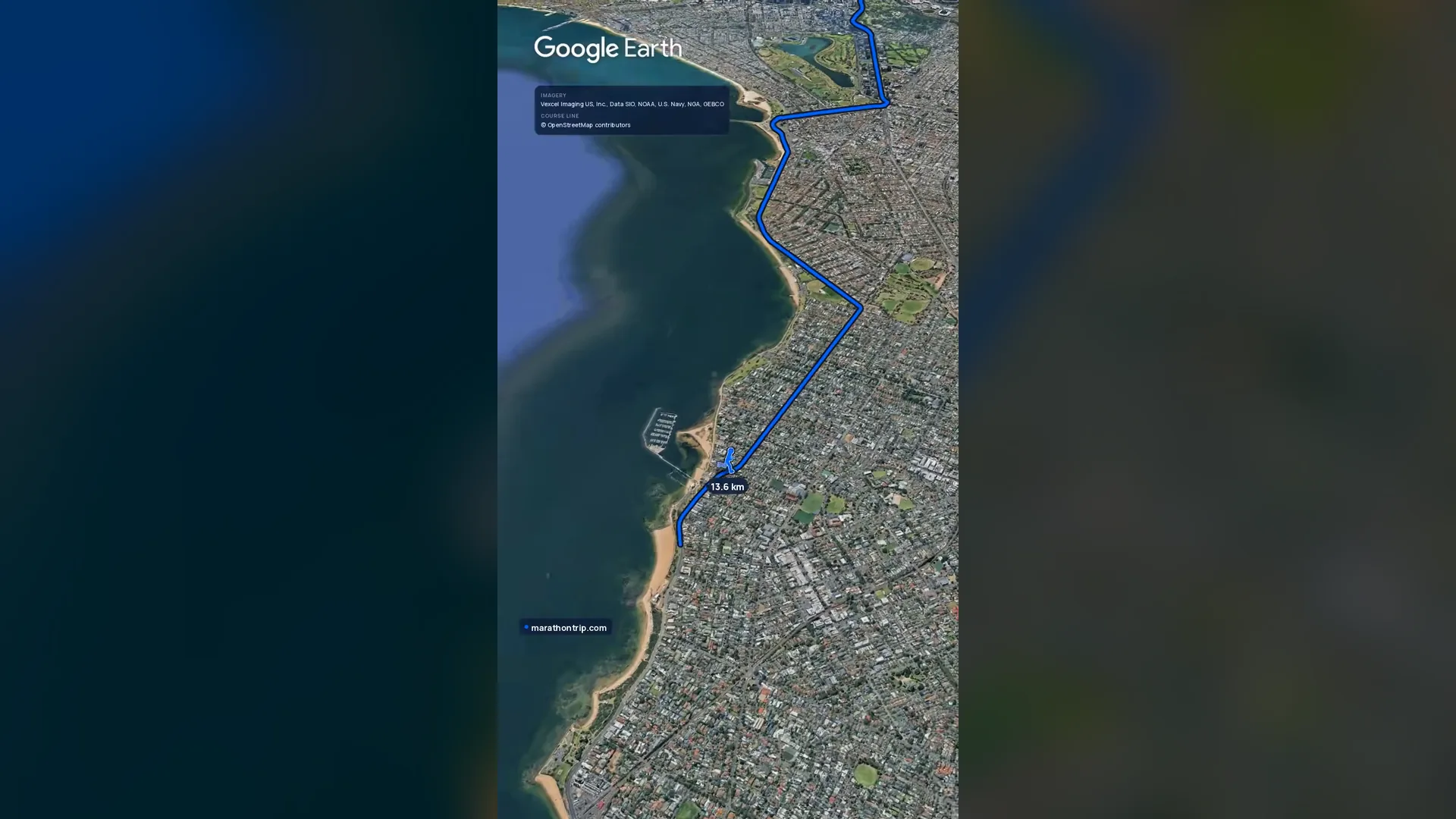
The bay road heads south: Jacka Boulevard past Luna Park (km 6.6 to 7.4), Marine Parade,
Ormond Esplanade, then St Kilda Street into Brighton from km 10.4, and the Esplanade at
Brighton to a U-turn at about km 13. The same roads bring you back north, past Luna Park again
at km 19.4. All of it lies between about 4 and 5.5 m, the longest truly flat stretch of the
race, and with the field running both ways on the same roads it is where you meet the runners
ahead of you coming back.
Km 19.4 to 26.7: Port Melbourne and halfway
km 21.8 Beaconsfield Parade and the Kerferd Road Pier
Beaconsfield Parade runs north-west along the foreshore to Beach Street in Port Melbourne,
where a U-turn at km 23 sends you back the way you came. Halfway, km 21.1, falls on this
stretch at 2.9 m, and the turn itself is the lowest point of the course: 2.4 m at km 22.9.
From km 8 to km 35 the road never leaves a band between 2.4 m and 10.9 m.
Km 26.7 to 35.5: Albert Park Lake
Km 33.5 Albert Park Lake
Photo: Donaldytong, Public domain
Fitzroy Street climbs away from the beach, from 7.8 m at km 26.7 to 10.9 m at km 27.4, and
Lakeside Drive takes the course into Albert Park. This is the fiddliest part of the race:
Ross Gregory Drive, then Aughtie Drive out to a hairpin at about km 29.3 and back, north on the
link road beside the lake, up the west side, across the top on Albert Road Drive and Aquatic
Drive (km 32.0 to 32.5), and south down the east side on Lakeside Drive to km 35.2. Most of the
lake loop sits between 4 and 5 m; the course climbs 10.7 m in all between km 26.7 and the park
exit, where it reaches 11.4 m. Fitzroy Street then returns you to St Kilda Junction.
Km 35.5 to 42.2: St Kilda Road home and into the MCG
Km 42.2 The finish inside the Melbourne Cricket Ground
Photo: Donaldytong, Public domain
This is where the old course hurt, with its climb up from Birdwood Avenue at about 36 km. The
2026 route stays on St Kilda Road instead, heading north on the west carriageway. It dips to
8.5 m at km 37.2 and rises gently to 12.1 m at km 39, then crosses Princes Bridge at km 39.8
and turns east on Flinders Street past Federation Square. The high point of the whole course,
16.5 m, comes at km 40.6 near the end of Flinders Street. The last 7 km add 13.1 m of climb:
noticeable on tired legs, never a hill.
Wellington Parade South, Jolimont Road and Barassi Way lead to the stadium. The course enters
through the stand and finishes on the arena of the Melbourne Cricket Ground at 11.3 m. The
last checkpoint, at 41.1 km, closed at 13:49 in 2026.
At a glance
distance
42.2 km26.2 mi
Loop, asphalt
climb
54.9 m180 ft
Highest point 14 m above lowest
cut-off
7:45 h
7 h 45 min. In 2026
finishers
14,500
Finishers in 2025
first held
1978
A flat loop from Batman Avenue: down St Kilda Road past the Shrine, along the bay to a turn at Brighton, back to a turn in Port Melbourne, round Albert Park Lake, and home up St Kilda Road to finish inside the Melbourne Cricket Ground.
Race week centres on the MCG. In 2026 the Race Week Office opened on the stadium’s external
concourse on Wednesday 7 October from 11:00 to 18:00, then from 08:00 to 18:00 on Thursday and
Friday and from 08:00 to 16:00 on Saturday. There were three separate offices, one for the
marathon, one for the half and one for the shorter races, so go to the one for your distance.
Marathon bibs had to be collected by Saturday, and there is no bib collection on race day. If
you land late, a friend or family member may collect your bib by showing the QR code from your
registration email, as long as you completed the participant waiver when you registered.
The Runners Expo sat on the same concourse between Gates 2 and 3, with the same hours plus
Sunday from 07:30 to 15:00. A partner expo ran in the MCG precinct and Yarra Park from Thursday
to Sunday.
Since 2026 the festival runs over two days, with the finish inside the MCG on both. Saturday
brings the 10 km at 07:00, the 5 km at 08:30, the 3 km at 09:15 and the children’s Mini Marathon
from 11:00, so the stadium is busy that morning and the roads around the start close from 04:00
to about 11:00.
Race morning
The marathon starts at 06:15 on Batman Avenue as one mass start, with runners released in
rolling order from allocated start zones; Preferred Start runners line up directly behind the
elite field. Your chip time begins when you cross the start arch. The organiser asks you to
arrive at least an hour before your start, which puts you near the MCG by about 05:15. Pacers
in 2026 covered finish times from 2:48 to 5:30.
Bag drop is at Run Lab in the Melbourne Park precinct, opposite Garden Square: from the MCG,
cross Rod Laver Bridge and turn right. It opened at 04:45 on race morning and takes bags only
on the morning of your own race, never the day before. Tie the Warm Clothing tag from the bottom
of your bib to your bag, and collect it before 14:30. In 2026 Gate 1 of the MCG opened for
toilets only, from 04:45 to 06:30. Personal drink drop-off has been discontinued.
The cut-off
The limit is 7 hours 45 minutes from the gun, and every runner must reach the MCG course entry
by 14:00 so the roads can reopen. Along the way there are 18 checkpoints, from 6.5 km (07:48)
to 41.1 km (13:49). The organiser advises runners at the back of the field to plan on about 7
hours 20 minutes of net time.
For the people watching
Supporters can walk into the MCG for free to see the finish: in 2026 through Gates 3, 4 and 5
from 07:30 to 14:00. The organiser suggests agreeing a meeting point in Yarra Park rather than
waiting at the finish. Out on the course, its spectator hub points people to Federation Square,
which runners pass in the first kilometre and again just after km 40, and to Anzac Station, at the other
end of a tram-free race corridor that runs from there to Federation Square.
Melbourne Airport lists buses, SkyBus, taxi ranks and rideshare pick-up as the ways into the
city, and puts the CBD about 30 minutes away. SkyBus runs its Melbourne City Express every 10
minutes from 04:00 to 01:00, seven days a week; a flight that lands between 01:00 and 04:00
leaves the taxi rank or a rideshare.
Where to base yourself
Choose a bed for a 06:15 start, which means one with an easy walk or train to Flinders Street
or Richmond, the two stations the organiser names as the most convenient for race morning. The
south edge of the CBD is on the course itself: Flinders Street, past Federation Square, is the
first kilometre, and Batman Avenue runs off its eastern end. The organiser adds extra
early-morning public transport services across the race weekend.
Be careful with a bed south of the river. On race day in 2026 St Kilda Road was closed from
04:00 to 13:00, and the bayside roads (Marine Parade, Beaconsfield Parade, Fitzroy Street,
Lakeside Drive) from 04:30 or 05:00 until late morning, and the organiser warns that the
closures affect tram and bus routes. St Kilda and Albert Park put you on the course near km 6
and km 27: good for watching, awkward for reaching the start.
If you drive, Yarra Park opened at 03:30 on race morning in 2026, with limited spaces at AUD 20,
card only, and entry through Gate 5 off Punt Road. For a drop-off, the organiser names Olympic
Boulevard outside Rod Laver Arena if you are heading straight to the start, and Wellington
Parade if you need the MCG or bag drop first.
Getting a place
General entries go by ballot. The 2026 ballot closed on 25 November 2025 and was drawn on 28
November, with more than 52,000 runners entered across the marathon and half together. For 2027
the organiser says only that ballot details “will be announced soon”, and its 2027 waitlist is
where that news lands first. If the ballot misses, the other ways in are a charity place
(raising at least AUD 2,000, subject to availability), a travel package from the organiser’s
travel partners with a guaranteed entry and accommodation, a qualifying time on an
AIMS-certified course, and a limited pathway through selected MARI events such as the Great
Ocean Road Running Festival.
Climb summed after smoothing the heights over 1 km. The edge is this course's height profile on one scale for every race: 250 m above its lowest point fills it.
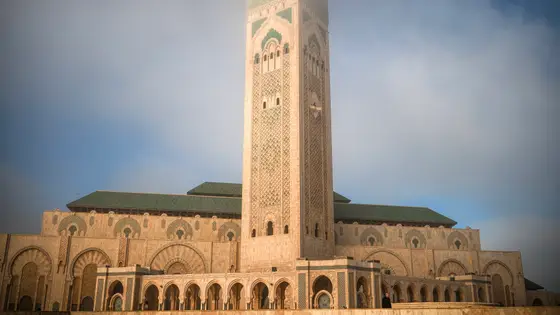
Climb summed after smoothing the heights over 1 km. The edge is this course's height profile on one scale for every race: 250 m above its lowest point fills it. Photo: Hassan II Mosque, by Tinuzzo, CC BY 4.0, via Wikimedia Commons.
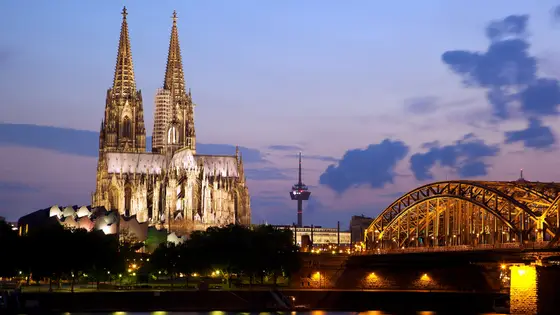
Climb summed after smoothing the heights over 1 km. The edge is this course's height profile on one scale for every race: 250 m above its lowest point fills it. Photo: Cologne Cathedral, by Jiuguang Wang, CC BY-SA 2.0, via Wikimedia Commons.
Climb summed after smoothing the heights over 1 km. The edge is this course's height profile on one scale for every race: 250 m above its lowest point fills it. Photo: Main Square, by Ingo Mehling, CC BY-SA 4.0, via Wikimedia Commons.
Climb summed after smoothing the heights over 1 km. The edge is this course's height profile on one scale for every race: 250 m above its lowest point fills it. Photo: Gyeongbokgung, by Frank Schulenburg, CC BY-SA 4.0, via Wikimedia Commons.
Climb summed after smoothing the heights over 1 km. The edge is this course's height profile on one scale for every race: 250 m above its lowest point fills it.
Questions about the Melbourne Marathon
When is the Melbourne Marathon 2027?
The organiser had not published the 2027 date when this was checked on 30 October 2026. The race is held in October; the 2026 edition was on Sunday 11 October with a 06:15 start. The organiser runs a 2027 waitlist for news of the date and the ballot.
How do I get an entry, and is there a ballot?
General entries are drawn by ballot. The 2026 ballot closed on 25 November 2025 and was drawn on 28 November 2025, with more than 52,000 runners entered across the marathon and half marathon together. The organiser says details of the 2027 ballot will be announced soon. Other ways in are a charity place (raising at least AUD 2,000), a travel package with a guaranteed entry, a qualifying time on an AIMS-certified course, and selected affiliate events.
How much does the Melbourne Marathon cost to enter?
In 2026 the marathon cost AUD 235 for Australian residents and AUD 295 for international entrants. The 2027 fees are not published yet.
10 more questions
Is the Melbourne Marathon course flat?
Yes. Measured along the 2026 course, the total climb is 54.9 m and the whole route stays within 14.1 m of one height, with its high point of 16.5 m at km 40.6. For 2026 the organiser removed the Birdwood Avenue to Domain Road climb at 36 km and says elevation gain fell by up to 20%.
What is the cut-off time for the Melbourne Marathon?
7 hours 45 minutes from the gun, and every runner must reach the MCG course entry by 14:00. There are 18 checkpoints on the course, the first at 6.5 km (07:48 in 2026) and the last at 41.1 km (13:49). The organiser advises back-of-field runners to plan on about 7 hours 20 minutes of net time.
How do I get to the start on Batman Avenue?
The organiser strongly suggests public transport and names Richmond and Flinders Street as the most convenient stations, with extra early-morning services across the race weekend. Arrive at least an hour before the 06:15 start. Parking in Yarra Park opened at 03:30 in 2026, cost AUD 20 by card only and was limited, with entry through Gate 5 off Punt Road.
Where and when do I collect my bib?
At the Race Week Office on the MCG's external concourse. In 2026 it opened from Wednesday to Saturday, and marathon bibs had to be collected by Saturday; there is no bib collection on race day. A friend or family member may collect it for you with the QR code from your registration email, provided you completed the participant waiver when you registered.
Are there pacers at the Melbourne Marathon?
Yes. In 2026 pacers covered finish times from 2:48 to 5:30.
How do I enter the Melbourne Marathon?
The 2027 ballot is not announced yet. Last time, for the 2026 race, the ballot closed on 25 November 2025 and the results came out on 28 November. There are 6 ways in: Ballot, 2027 waitlist, Run for a cause, Official travel packages, Qualifying standard and Affiliate events. Entry fee: A$235 (A$295 from abroad, for the 2026 race). Entry details on the organiser’s site
What is the time limit at the Melbourne Marathon?
In 2026 runners had 7 h 45 min to finish.
How many runners finish the Melbourne Marathon?
14,500 runners finished in 2025.
What are the course records at the Melbourne Marathon?
Melbourne staged its first marathon in 1978, on a Boston-style point-to-point course that began
in Frankston and finished outside the Town Hall; 1,947 runners finished, about 4% of them women.
In 2007 the start moved near the MCG and the finish into the stadium, and the 2026 race marked
20 years of finishing inside the MCG. IMG owned the event from 2006 to 2025, when ownership
passed to MARI, which organises it now.
The organiser calls it the biggest marathon in Australia by finishers. In 2019 it set an Australian record of 7,037 finishers. The pandemic
broke the run of October races: 2020 was cancelled and held virtually in December, and 2021
moved to 11 and 12 December after lockdown restrictions, with starts an hour earlier for the
warmer weather. October returned in 2022. By 2025 the marathon had 14,500 finishers and the
whole festival a record 50,000 participants; the 2026 weekend, the first as a two-day festival
with the marathon field set at 20,000, drew more than 60,000.
In 2026 Eliud Kipchoge ran Melbourne as part of his
tour of marathons on all seven continents and won in 2:09:10, two seconds under the race record
of 2:09:12 that Timothy Ronoh set in 2022, with Do Canto second in 2:10:35. Camille
French of New Zealand won the women’s race in 2:28:25, with Sinead Diver second in 2:28:49.
Diver still holds the women’s course record, 2:25:19 from 2018, set on the earlier course.
Izzi Batt-Doyle’s 2:28:10 in 2022 is listed by the organiser as the fastest Australian marathon
debut, and she also holds the women’s half marathon record, 1:08:55 from 2025.