
Entry through the organiser
Entry details on the organiser’s site →
AD. MAPOMA, a third party. We take no entries and have no part in the race.
 Marathon Trip
Your trips on every device: sign in, or make a free account when you save one.
Signed in on this browser.
Sign in My marathons Account and dataLocked out? An export link you keep still opens your list in any browser.
No account: email it to me
One email with this trip and a link to open it again. We do not keep the address and send nothing else.
Only a race from our list can be emailed. An account keeps this one.
What we keep, and what we do notCheck your inbox at to confirm it.
Browse the racesEach edition the day it comes out, and nothing else. Off again with one click. How it is kept.
A climb of 53 m to km 4, downhill from km 15 to km 25, then another climb of 66 m home from km 36.
© OpenStreetMap contributors
km 1.8mile 1.1
Real Madrid's stadium beside the Paseo de la Castellana, passed in the first 2 km.
Photo: Zoser, CC BY 4.0
km 3.5mile 2.2
The two leaning towers at Plaza de Castilla, at the north end of the Castellana.
Photo: Zarateman, CC0
km 19.8mile 12.3
The arcaded square of Habsburg Madrid, passed just before the Royal Palace.
Photo: Zarateman, CC0
km 20.5mile 12.7
The Royal Palace, with the Almudena cathedral beside it.
Photo: Tim Adams, CC BY 3.0
km 21.6mile 13.4
The square at the top of the Gran Vía, with the Edificio España behind it.
Photo: Manuel M. Vicente from Spain, CC BY 2.0
km 29.1mile 18.1
Madrid's great western park, which the course enters between km 28 and 32.
Photo: Håkan Svensson Xauxa, CC BY 2.5
km 34.4mile 21.3
The old stone bridge over the Manzanares on the Madrid Río promenade.
Photo: Javier Blesa Martínez from Madrid ( Spain ), CC BY 2.0
km 41.3mile 25.6
The Prado, on the Paseo del Prado a kilometre before the finish.
Photo: Zarateman, CC0
km 41.9mile 26
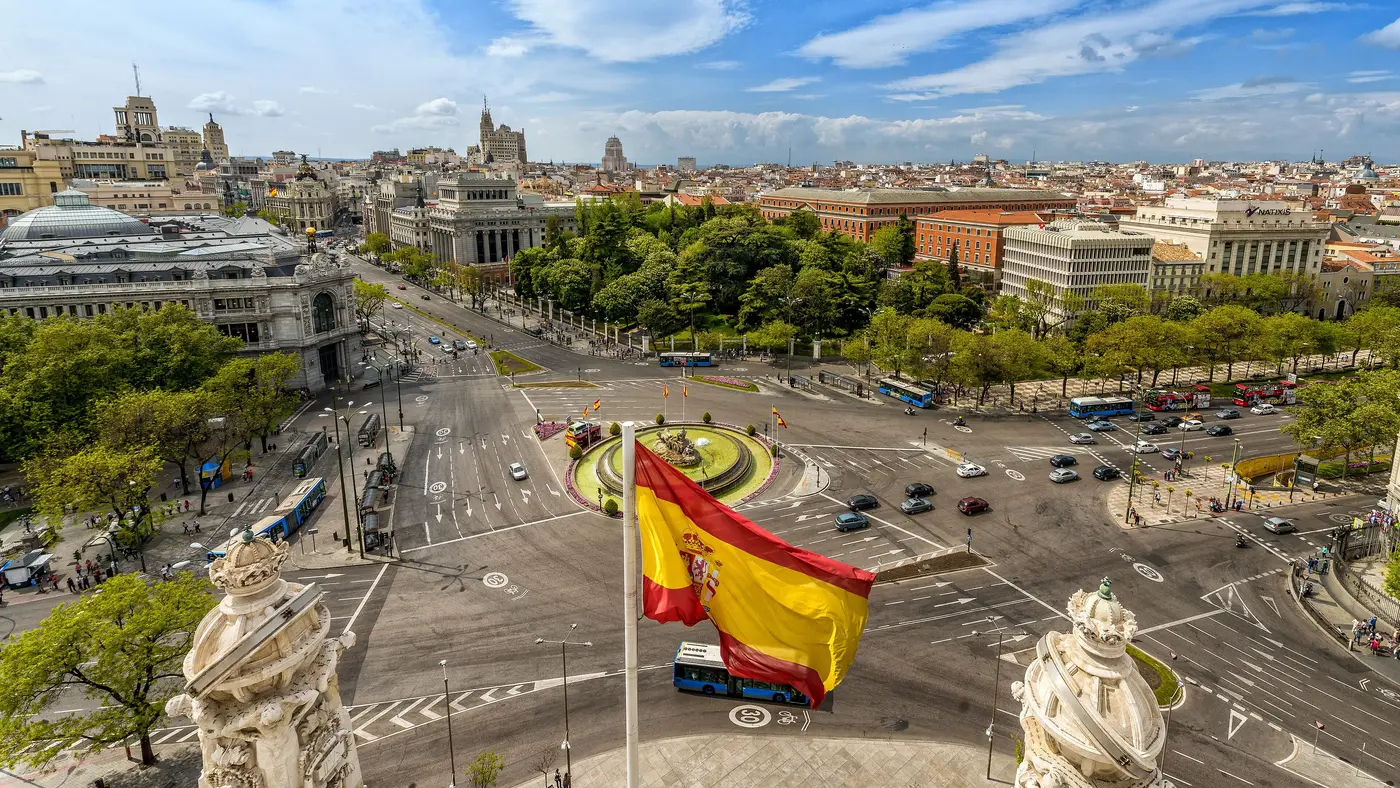
Cibeles fountain and the Palacio de Comunicaciones, in the last 400 m.
Photo: Nicolas Vigier, CC0
km 42.1mile 26.1
The gate beside the Retiro, a few hundred metres from the finish.
Photo: Alvaro Gandara Astray, CC BY 2.0
Height drawn many times taller than life. Heights: MDT05.
Dashed: bridge upright dashes: cut-offs

Your 5 gels, at the orange marksFor a 4:00 finish, one every 40 minutes
Get them on AmazonAmazon partner link
Madrid hands out its height early and asks for it back at the end. The start, on the Paseo de la Castellana, is already at 675.7 m, and the road climbs to the course’s highest point, 728.3 m, by km 3.7. From there most of the race runs downhill, through the old centre at halfway, out through the Casa de Campo and over the Manzanares, to the low point at km 36.3. The last 5.8 km then climb 66 m up to Cibeles. A runner who banks time on the long descent and has nothing left for the Paseo del Prado will feel every metre of it.
The course is point to point, from the Castellana in the north of the city to the Paseo de Recoletos in the centre. The kilometres, streets and heights below are measured along the organiser’s 2026 course file, matched to the streets, on Spain’s 5 m national elevation model. The 2027 course map is published only as an image, so check it on the organiser’s site for any change before you plan your pacing.
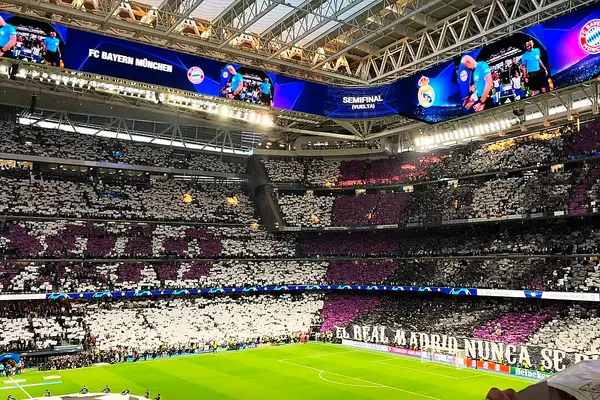
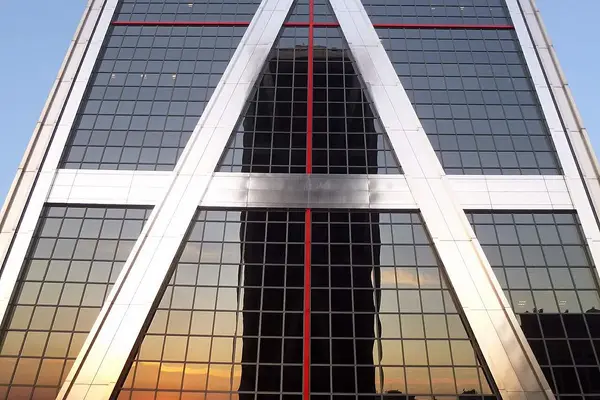
The start is on the Paseo de la Castellana beside Plaza de San Juan de la Cruz, and the road runs uphill from the gun. The course heads north up the Castellana, loops through Concha Espina and passes the Bernabéu stadium at km 1.8, already 22 m above the start line. Padre Damián and Alberto Alcocer bring it back to the Castellana, and at Plaza de Castilla the two leaning towers of the Puerta de Europa stand at km 3.5. The top, 728.3 m, is at km 3.7. The first 3.7 km climb 52.6 m, so a slow first kilometre split is the course, not the runner.
From Plaza de Castilla the course turns south down Calle de Bravo Murillo to Cuatro Caminos at about km 6.1, falling about 20 m on the way. It then runs east along Raimundo Fernández Villaverde, Joaquín Costa and Francisco Silvela, still losing height gently, to about 682 m by km 9.8.
Doctor Esquerdo, O’Donnell and Alcalá lead into a run of straight streets: Goya, Príncipe de Vergara past Plaza del Marqués de Salamanca, Goya again, Velázquez, Diego de León and Serrano. This stretch is nearly level, between about 674 m and 681 m, with a small rise towards km 15.6.
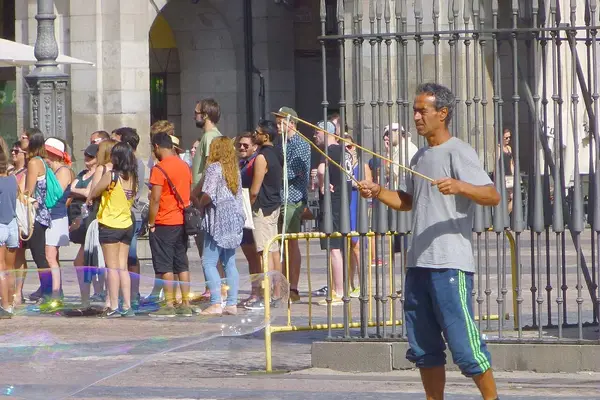
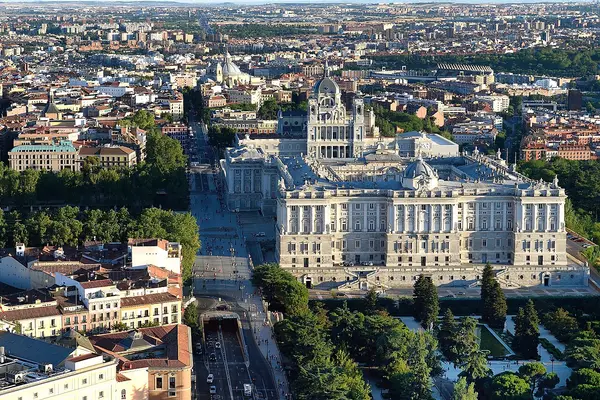
The course crosses the Castellana on the Enrique de la Mata Gorostizaga bridge at about km 16 and runs through Almagro, Sagasta, Carranza and San Bernardo to the Gran Vía at about km 18.8. Then it goes through Habsburg Madrid: down Preciados and Calle Mayor, past the Plaza Mayor at km 19.8, and along Calle de Bailén past the Royal Palace, with the Almudena cathedral beside it, at km 20.5. Halfway, km 21.1, comes as the course reaches Plaza de España, at 634 m, 94 m below the high point. The square brings a small rise back to 639 m at km 21.6.
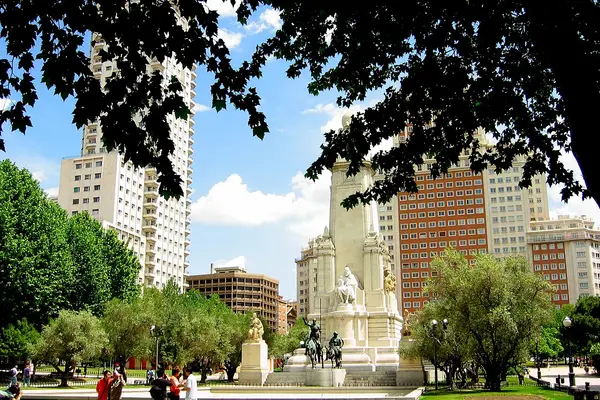
The steepest sustained fall of the race comes straight after halfway. Princesa and Marqués de Urquijo lead on to the Paseo de Camoens, Ruperto Chapí and the Avenida de Valladolid, and the road falls 66 m between km 22.3 and km 25.2. It is the easiest place to run too fast, with the climb home still to come. The Paseo de la Florida leads on towards the park.
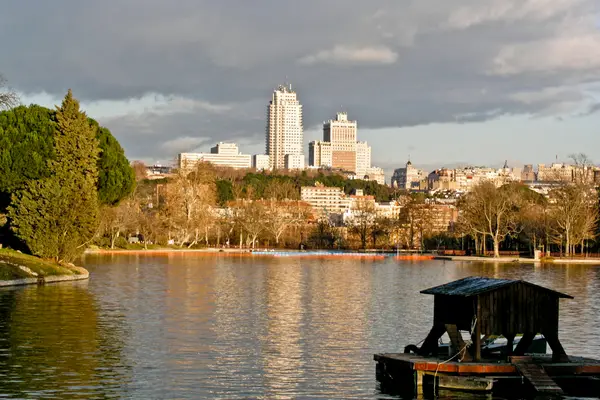
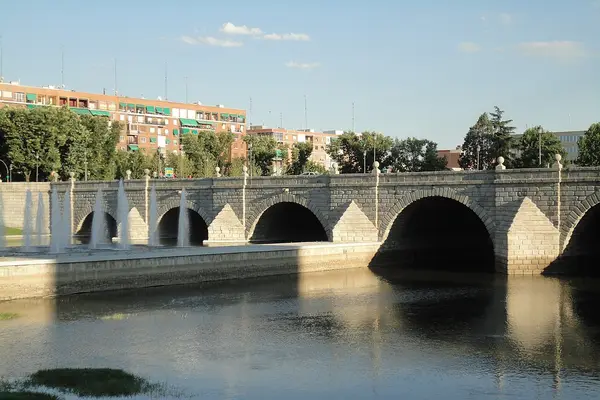
The course enters Casa de Campo, Madrid’s big western park, between km 28 and km 32, on the park’s own roads: Paseo de María Teresa, Paseo de los Castaños and Paseo del Robledal. Inside the park it rises from 601 m to 622 m at km 30.2 before falling again. From km 24.5 to km 38 the course never goes above 622 m or below 578 m, so this is rolling ground rather than a hill. The Paseo Puerta del Ángel and the Avenida de Portugal bring it out of the park, and at km 34.4 it reaches the old Puente de Segovia.
The Paseo de la Ermita del Santo leads to the Puente de San Isidro, which carries the course over the Manzanares from about km 35.5. On the far bank, on the Paseo de la Virgen del Puerto, it reaches its lowest point, 578.2 m, at km 36.3.
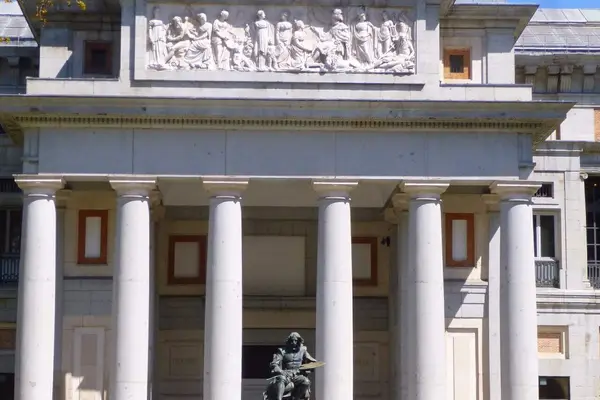
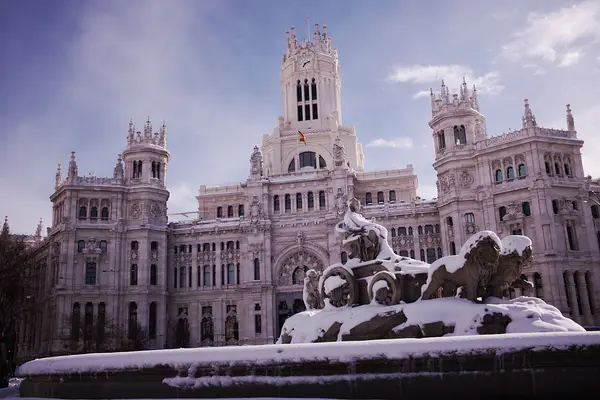
From the low point the course climbs to the finish: 66 m in 5.8 km, about 1.1% on average, in the last 6 km of a marathon. It goes up Calle de Segovia and the Ronda de Segovia, along the Paseo Imperial and the Paseo de las Acacias, and round the Ronda de Valencia and the Ronda de Atocha to Plaza del Emperador Carlos V at about km 40.5. The Paseo del Prado then carries it past the Prado at km 41.3, at 634 m, to the Cibeles fountain at km 41.9, at 642 m. The finish is on the Paseo de Recoletos, between Plaza de Cibeles and Plaza de Colón, at 644 m.
The organiser counts more than 30 cheering points along the course, and the city’s tourist board says almost twenty live rock bands play beside it.
A run down the Paseo de la Castellana past the Royal Palace and Casa de Campo, finishing on the Paseo de Recoletos between Plaza de Cibeles and Plaza de Colón.
The Madrid Marathon is a hilly point-to-point course of 42.2 km with 206 m of climbing. Its lowest point is 578 m and its highest 728 m above sea level. Next race: Sunday 25 April 2027.
Bib pickup at IFEMA, Feria de Madrid
6 May 2026
11 May 2026
14 May 2026 · 10:0010:00 AM
1 Feb 2027
15 Mar 2027
15 Mar 2027
18 Mar 2027 · 00:0012:00 AM
Time not published
10:0010:00 AM–20:008:00 PM
10:0010:00 AM–20:008:00 PM
07:007:00 AM–17:005:00 PM
until 16:354:35 PM
Time not published
Time not published
08:308:30 AM
until 10:1510:15 AM
until 11:0011:00 AM
until 11:4511:45 AM
until 12:3012:30 PM
until 13:151:15 PM
until 14:002:00 PM
until 14:452:45 PM
until 15:303:30 PM
until 16:154:15 PM
Times as published by AD. MAPOMA, in Madrid time, checked .
The forecast for Sunday
We hold no start time for this race, so the record is read at 09:009:00 AM, local time.
Add to calendar .ics file, times in Madrid time
The organiser’s FAQ and 2027 rules are already published. The final instructions and the bib pick-up QR code are emailed on Monday 19 April 2027. If the QR code has not arrived by 21 April, download the registration receipt from the registration manager instead.
The Feria del Corredor, the runners’ expo, is at IFEMA, Feria de Madrid, on Friday 23 and Saturday 24 April 2027, from 10:00 to 20:00 without a break. Entry is free and open to the public. Bring the pick-up QR code or the registration receipt, and a DNI, passport or other photo ID. The FAQ allows someone else to collect for you with the receipt or QR code and your photo ID. You get the bib, the official T-shirt and the runner’s bag, which takes about 15 minutes, and the organiser suggests Friday morning or Saturday afternoon to avoid the queues. No bibs are handed out on race day, so the expo is not optional.
Runners are split into waves by the expected finish time given at entry. Entries made from 18 March 2027 are not guaranteed a personalised bib or a corral matched to their time. The wheelchair and handbike start is at 08:30, and every handbike must be escorted by a conventional bicycle. The organiser still lists the first-wave start time for 2027 as to be determined. The city’s tourist board gives 08:45, and in 2026 the marathon and the half marathon started together at about 08:45, so treat 08:45 as likely but not confirmed. Marathon pacers run targets from under 3 hours to 5 hours, each from the corral that matches its time.
The baggage area is in the finish area, on the Paseo de la Castellana between Hermosilla and Ortega y Gasset. It opens at 07:00 on race day and the marathon bags must be collected by 17:00. Only the official baggage bag, with its numbered sticker, is accepted, and the organiser is not liable for what is in it.
The marathon has water at km 5, 10.5, 16, 20, 25, 29, 32, 35.8, 38 and 40 and at the finish, and Powerade at km 5, 11, 15, 23, 26.5, 29, 32, 35.8, 38 and 40 and at the finish. There are bananas at km 23, 29 and 38 and at the finish, and an extra gel station at km 30. Every runner also gets a 226ERS fuel bag. The organiser may move these points for operational reasons.
The 2027 rules print a maximum passing time at every kilometre, 9 minutes apart: 10:15 at the start line, 11:45 at km 10, 13:24 at km 21, 14:45 at km 30, 16:15 at km 40 and 16:34:45 at the finish. The FAQ says the event ends at 16:35. Both still list the marathon’s time limit and first start as to be determined, so the table may change once they are set. A runner caught by the closing car can speed up or board the sweep vehicle.
Entry through the organiser
AD. MAPOMA, a third party. We take no entries and have no part in the race.
Metro line 8 runs between Nuevos Ministerios and the airport. It takes less than 20 minutes to Terminal 4 and 12 minutes to the other terminals, and the airport station adds a 3 EUR supplement. The C-1 commuter train serves Terminal 4, with a train every twenty minutes. The Airport Express bus 203 runs from Atocha station from 06:00 to 23:30, takes about 30 minutes from Atocha to Terminal 1, and costs 5.10 EUR. A taxi between the airport and the city centre, inside the M-30 ring road, is a fixed 33 EUR.
The start is on the Castellana by Plaza de San Juan de la Cruz, the bag drop is on the Castellana between Hermosilla and Ortega y Gasset, and the finish is on Recoletos between Cibeles and Colón, all along the same line of avenues. Anywhere within walking distance of that stretch, from Gregorio Marañón down to Cibeles, puts the start, the bags and the finish on foot. Otherwise stay near a station on Metro lines 5, 7 or 10, which the organiser names for the start. The expo at IFEMA is a separate trip on the Friday or Saturday.
The organiser recommends public transport to the start: Metro lines 7 and 10 to Gregorio Marañón, or line 5 to Rubén Darío. Near the finish the tourist board names Colón on line 4, Rubén Darío on line 5 and the Madrid-Recoletos commuter rail station. Do not plan to park near the finish: the organiser says the whole area is closed until the race closes. The course is fully urban and closed to traffic. No street-by-street closure list had been published at the time of writing.
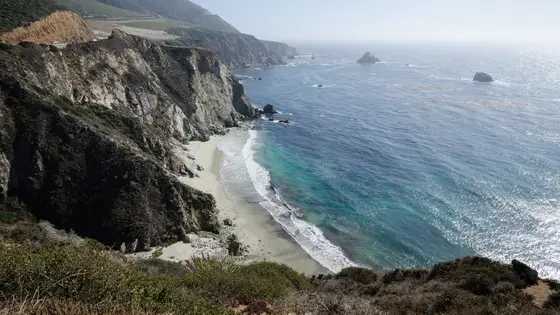
Big Sur, United States
Sun 25 Apr 202742.2 kmClimb 288 m
Climb summed after smoothing the heights over 1 km. The edge is this course's height profile on one scale for every race: 250 m above its lowest point fills it. Photo: Bixby Creek Bridge, by Tuxyso, CC BY-SA 3.0, via Wikimedia Commons.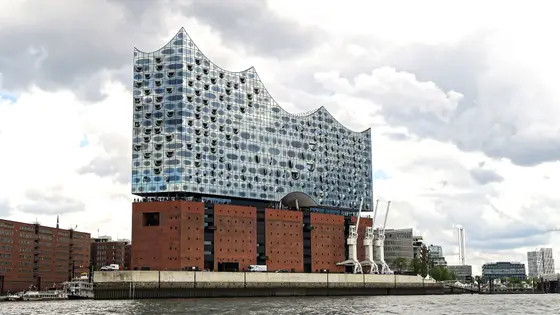
Hamburg, Germany
Sun 25 Apr 202742.2 kmClimb 98 m
Climb summed after smoothing the heights over 1 km. The edge is this course's height profile on one scale for every race: 250 m above its lowest point fills it. Photo: Elbphilharmonie, by Burkhard Mücke, CC BY-SA 4.0, via Wikimedia Commons.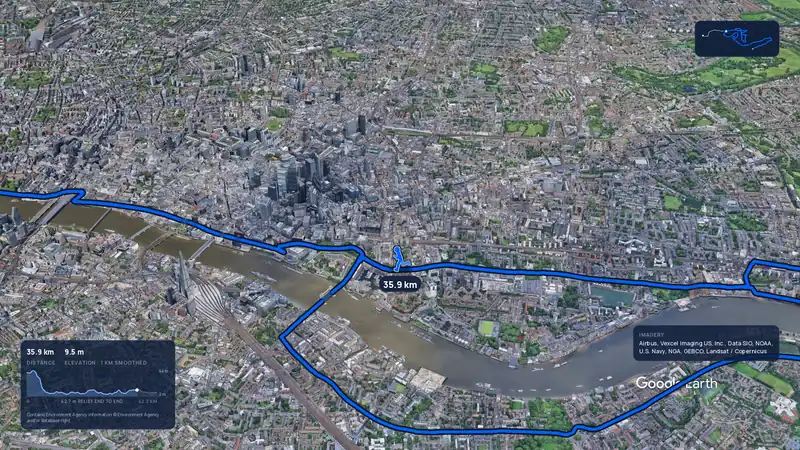 Imagery: Google Earth4:02 film
London, United Kingdom
Sun 25 Apr 202742.2 kmClimb 42 m
Climb summed after smoothing the heights over 1 km. The edge is this course's height profile on one scale for every race: 250 m above its lowest point fills it.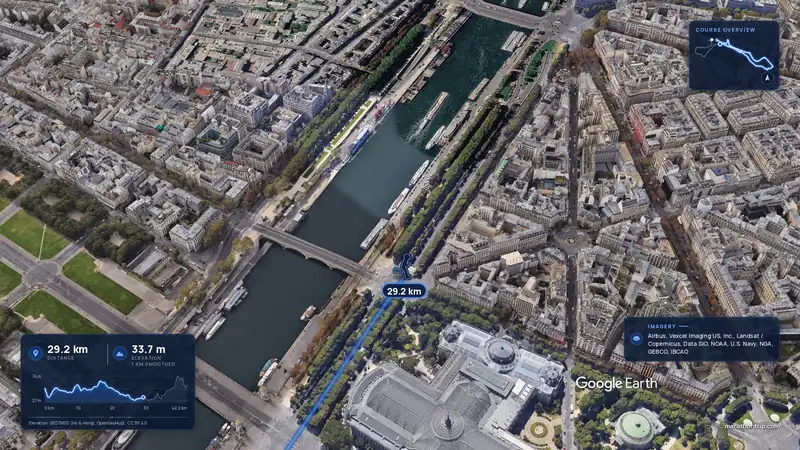 Imagery: Google Earth3:56 film
Paris, France
Sun 4 Apr 202742.2 kmClimb 142 m
Climb summed after smoothing the heights over 1 km. The edge is this course's height profile on one scale for every race: 250 m above its lowest point fills it.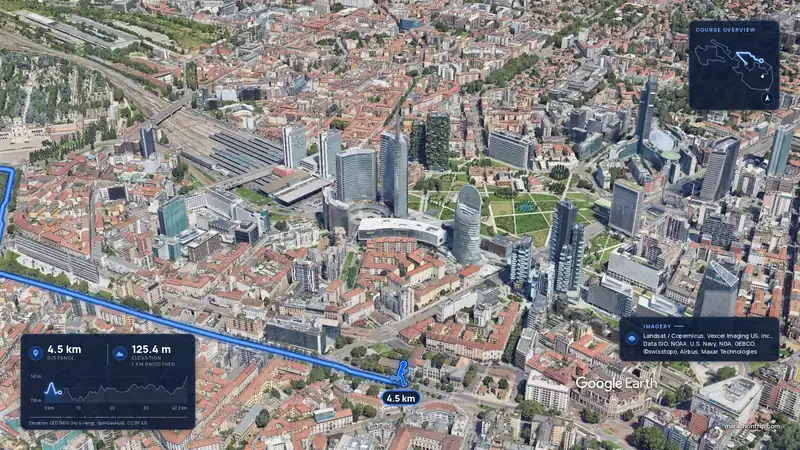 Imagery: Google Earth3:52 film
Milan, Italy
Sun 4 Apr 202742.2 kmClimb 88 m
Climb summed after smoothing the heights over 1 km. The edge is this course's height profile on one scale for every race: 250 m above its lowest point fills it.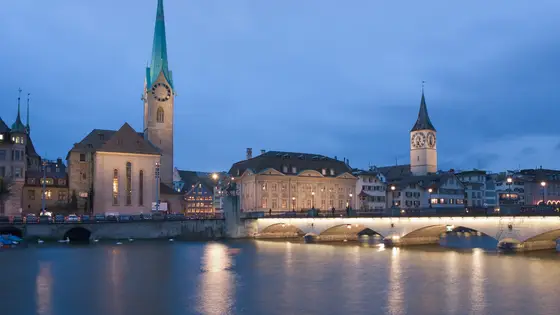
Zurich, Switzerland
Sun 11 Apr 202742.2 kmClimb 27 m
Climb summed after smoothing the heights over 1 km. The edge is this course's height profile on one scale for every race: 250 m above its lowest point fills it. Photo: Zürich, by Ikiwaner, CC BY-SA 3.0, via Wikimedia Commons.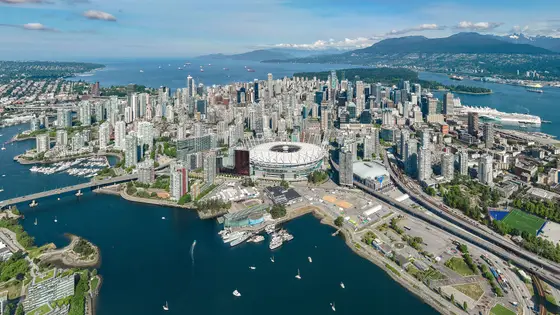
Vancouver, Canada
Sun 2 May 202742.2 kmClimb 198 m
Climb summed after smoothing the heights over 1 km. The edge is this course's height profile on one scale for every race: 250 m above its lowest point fills it. Photo: Vancouver, by Quintin Soloviev, CC BY 4.0, via Wikimedia Commons.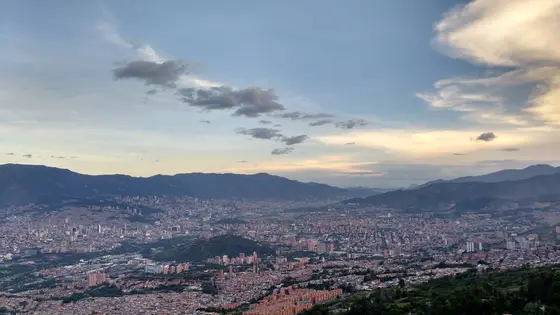
Medellín, Colombia
Sep 202742.2 kmClimb 191 m
Climb summed after smoothing the heights over 1 km. The edge is this course's height profile on one scale for every race: 250 m above its lowest point fills it. Photo: Medellín, by Luis90f, CC BY-SA 4.0, via Wikimedia Commons.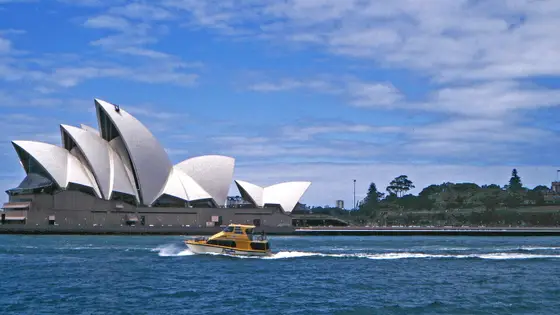 Ballot open
Sydney, Australia
Sun 29 Aug 202742.2 kmClimb 188 m
Climb summed after smoothing the heights over 1 km. The edge is this course's height profile on one scale for every race: 250 m above its lowest point fills it. Photo: Sydney Opera House, by W. Bulach, CC BY-SA 4.0, via Wikimedia Commons.Sunday 25 April 2027, the 49th edition. The organiser still lists the first-wave start time as to be determined. The city's tourist board gives 08:45, and in 2026 the marathon and the half started together at about 08:45.
At the runners' expo at IFEMA, Feria de Madrid, on Friday 23 and Saturday 24 April 2027, 10:00 to 20:00 without a break. Bring the pick-up QR code or your registration receipt and a DNI, passport or other photo ID. No bibs are handed out on race day.
The 2027 rules print a maximum passing time at every kilometre, 9 minutes apart, from 10:15 at the start line to 16:34:45 at the finish, and the FAQ says the event ends at 16:35. The organiser still lists the marathon time limit itself as to be determined, so the table may move. Runners caught by the closing car speed up or board the sweep vehicle.
It climbs 52.6 m in the first 3.7 km to its high point, then loses height for most of the way to km 36.3, the low point at 578.2 m. The last 5.8 km climb 66 m to the finish, about 1.1% on average. The figures are for the 2026 course.
The start is on the Paseo de la Castellana by Plaza de San Juan de la Cruz. The organiser recommends public transport: Metro lines 7 and 10 to Gregorio Marañón, or line 5 to Rubén Darío. Do not drive: the whole area around the finish is closed until the race closes.
Yes. The organiser's FAQ lists marathon pacers from under 3 hours to 5 hours, each starting from the corral that matches their target time.
Yes, until 15 March 2027, through the Traspasar Inscripción option for a 10 EUR fee, or by listing the place on the organiser's Market Place.
No, it is a hilly course: 206 m of climbing over 42.2 km. The highest point is 150 m above the lowest. It finishes 32 m lower than it starts.
The first Madrid Marathon was run in 1978, and the 2020 race was cancelled because of the coronavirus pandemic, which makes 2027 the 49th edition. In April 2011 the American Competitor Group, owner of the Rock ‘n’ Roll series, partnered with the organiser, Mapoma, in what was the series’ first event outside the United States. A 10 km race had been added in 2010, and the half marathon followed in 2012. The race holds a World Athletics Gold Label, and since 2026 it has been part of the European Marathon Classics.
The race day has grown fast. More than 40,000 people ran in 2024, and 2026 set a record of 47,000 runners across the three races, from 113 countries, 13,210 of them from abroad. More than 8,000 runners were left on the waiting list without a bib. For 2027 the organiser plans 47,000 places again: 30,000 in the half marathon and 17,000 in the marathon.
The course records are Reuben Kerio’s 2:08:18 for the men, set in 2019, and Siranesh Yirga’s 2:24:37 for the women, set in 2022. The organiser names both runners but publishes no times, and the times here are Wikipedia’s. Neither fell in 2026: Mike Chematot of Kenya won in 2:08:46, 28 seconds outside Kerio’s mark, ahead of Asefa Mengisa (2:09:06) and Dechasa Alemu (2:09:10), and Kena Girma of Ethiopia won the women’s race in 2:26:00. Derara Hurisa (2:09:11) and Maritu Ketema (2:25:55) won in 2025, and Miktu Tafa (2:08:57) and Naom Jebet (2:26:20) in 2024.
Checked against these sources on .